
This item is no longer available.
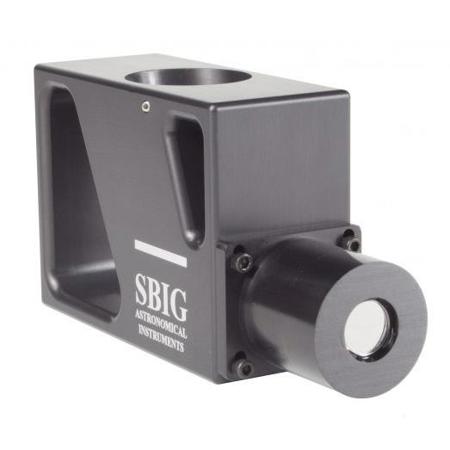
The SBIG ST-I Spectrograph attaches to the ST-I eyepiece camera, turning it into a low-cost spectrograph. This is an excellent learning/education tool for both school and home user's.
SBIG's ST-I spectrograph was designed specifically for our ST-I camera. This unit is intended to enable an amateur to characterize their skies, flat field sources, filter passbands, and other light sources. Its main purpose is to allow an amateur to measure his sky spectrum, and optimize his flat field sources to better match his conditions. The reason why this is important can be found in an article by Alan Holmes titled Flat Fields - The Ugly Truth. This unit also provides a good way for an amateur to compare his light pollution situation to user's at other sites.
The design is simple: light enters the spectrograph through a 25 micron entrance slit and is collimated by an achromatic lens. It then passes through the Schott SF11 glass prism, where blue light is bent through a greater angle than red wavelengths. A second achromat focuses the light onto the CCD, with an additional plano-convex lens to shorten the focal length and increase the photographic speed of the system to F/3.66. The speed is important when trying to capture the sky background. The plane of the CCD is actually tilted a little bit relative to the angle of incidence of the light to reduce the contribution of chromatic aberration to the optical blur.