
See Options
Need help? Ask our experts.
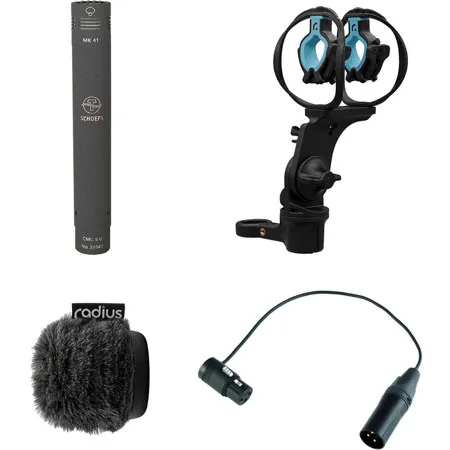
- CMC 6 Microphone Amplifier -
The CMC 6 is our most popular amplifier.
Its electrical properties have set new standards in terms of low distortion levels and common mode rejection (i.e. suppression of interference induced in the microphone cable).
Flat frequency response very low harmonic distortion and noise works with 12V and 48V phantom power balanced, low-impedance output high suppression of interference on the microphone cable excellent protection against high-frequency radio interference with "RFI Shield" frequency-independent impedance signal transmission possible over very long cables reliable operation even with weak phantom power symmetrical, transformer- and capacitor-free output stage with a class-A amplifier above 20 kHz, the signal is attenuated for protection against interference in the ultrasonic range, e.g. through the ultrasonic autofocus of a film camera.
The capsules of condenser microphones can't be connected directly to microphone cables or inputs; a microphone amplifier is required in between. Thus a complete microphone of the Colette series comprises any of the twenty available types of capsules combined with an amplifier. The CMC 6 U is designed for standard 48- and 12-Volt phantom powering. Its circuitry recognizes the supply voltage and adjusts itself automatically. Its performance characteristics remain essentially the same either way; mainly, the difference is that the current drawn at 12 Volts is greater than at 48 Volts. However, the 12-Volt mode consumes less power and might be preferred for battery-powered recording.
The microphone amplifier is responsible for providing the necessary electric charge to the capsule, without which it would be unable to generate a signal. Since the capsule's output signal is very weak (Hi-Z), it must be amplified. In order for the microphone's output to cleanly reach the next stage in the signal chain, it must undergo balancing and impedance matching before transmission. The CMC 6 incorporates a balanced, direct-coupled class-A amplifier, yielding a low output impedance, high RF shielding, and minimal distortion.
- MK 41 Microphone Capsule -
The MK 41 effectively attenuates diffuse sound energy and produces a clear, "dry" sound pickup.
Its polar pattern is exceptionally frequency-independent: sounds from the side and back are strongly attenuated, but picked up without false coloration. This feature has made the MK 41 an international standard for indoor film sound. The susceptibility of the MK 41 to acoustic feedback is lower than with any other SCHOEPS capsule type, provided that no loudspeaker radiates directly from the rear. The sensitivity minimum of the supercardioid occurs at approximately a 125 Degree angle of incidence.
The directional effect is independent of frequency, so that off-axis and diffuse sound are picked up free of false coloration, thus sounding natural. That is a real advantage over shotgun microphones, which have appreciably greater directivity only at higher frequencies, and frequency response (and thus sound quality) that depends on the direction of sound incidence.
Thus for many situations the MK 41 offers an interesting alternative to a shotgun microphone, even if its small dimensions do not appear to suggest high directivity. As a capsule without an interference tube in front of it, the MK 41 can also be placed closer to the sound source.
- RAD-2 Shockmount with XLR cable -
The RAD-2 suspension is designed for use with longer and/or heavier microphone/windscreen combinations, especially with windscreens such as the Radius Nimbus, Rycote Softie or CINELA LEO. It offers exceptional damping of boom motion and solid-borne sound. The RAD-2's isolators are somewhat thicker than those of the RAD-1, with 3 mm of additional, strong bracing on top in order to carry the extra weight of front-heavy microphones.
Compatibility:
CMC 6, CMC 6/CUT 60, CMD 42, MiniCMIT, CMIT 5, SuperCMIT designed especially for use with foam or other lightweight, removable windscreens (for larger, heavier windscreens the RAD-2 is recommended)
The holder has soft-coated universal microphone clamps that are suitable for any microphone with a diameter of 19-25 mm. Each bracket contains one pair of standard isolators (black), one pair of softer isolators (dark gray) and one pair of extra-firm isolators (dark blue). The RAD-2 hoops are slightly thicker than the RAD-1 isolators, with an additional 3 mm thick brace on top to support the extra weight of front-heavy microphones. All components are precision injection molded from virtually indestructible thermoplastic elastomers in an ISO-9000 certified factory, not 3-D printed.
RAD XLR cable No. RAD-00612
This short 3-pin XLR cable is suitable for all RAD suspensions. The cable is 275 mm long and has a 90-degree XLR-3F socket connector and a straight XLR-3M plug connector. The cable length and width are designed to fit into the strain relief, with additional clearance for repositioning of microphones.