
This item is no longer available.
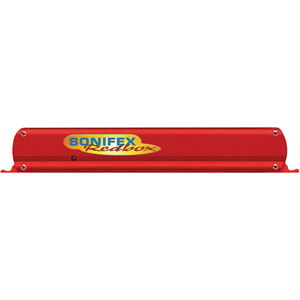
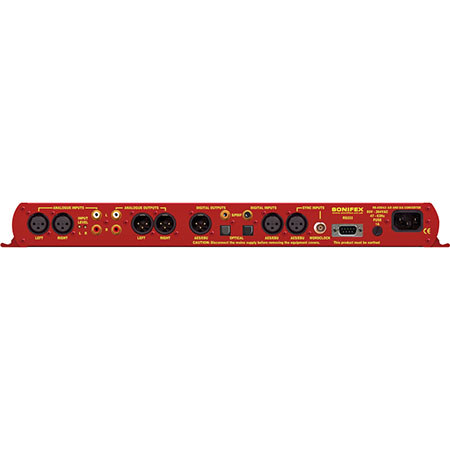
The Sonifex RB-ADDA2 A/D and D/A converter is a 1U rack-mount which produces an AES/EBU, S/PDIF or TOSlink optical level digital audio output from a balanced XLR or unbalanced phono stereo audio input. It also produces a stereo balanced XLR or unbalanced phono output from an incoming AES/EBU, S/PDIF or TOSlink optical digital input signal. It supports higher sample frequency rates up to and including 176.4kHz and 192kHz.It has additional independent AES/EBU and Word Clock synchronizing inputs, so that the A/D and D/A sections can operate independently, with the digital outputs synchronized to an external master reference clock.
It has TOSlink optical digital audio input and output and front panel push-button switches for all the main settings. The buttons are arranged in sets, where pressing the button advances the current selection and LED indicator. A serial RS232 port is included so that the RB-ADDA2 settings can be controlled remotely. The front panel LED indicators alter automatically when using RS232 commands.
The A/D source push-button is used to select from either the balanced or unbalanced stereo analogue inputs and this push-button also defines the input level for full scale digits at one of +12dBFS, +18dBFS or +24dBFS. These values can then be fine-tuned by using rear-panel pre-set potentiometers which give another +/-3dB of gain adjustment, allowing a signal range from +9dBu to +27dBu. The RCA phono inputs have a further 10dB gain incorporated to give a total gain range of -1dBu to +17dBu for full-scale digits.
For the digital output, there are three push-button switches to select the sample frequency, bit depth and status bit modes. The frequency button allows selection of the master sample frequency from one of 32kHz, 44.1kHz, 48kHz, 88.2kHz, 96kHz, 176.4kHz or 192kHz. The BITS button sets the output bit depth as one of 16, 20 or 24 bits and the CS DATA button defines the content of the channel status bits embedded within the digital audio stream. The status bits can be forced to either Professional Mode (PRO), Consumer Mode (CON) or to follow the mode of the input (FOLLOW).The SYNC button is used to select the synchronization input, from Word Clock, AES/EBU or the D/A input and also the synchronization mode of the digital output.
Master Mode
In this mode the unit receives an analogue audio signal, which is digitized and formatted for digital serial transmission (IEC958). The necessary clock signals are generated internally from an on board master clock at a selectable rate (32kHz, 44.1kHz, 48kHz, 88.2kHz, 96kHz, 176.4kHz or 192kHz).
Slave Mode
In this mode the unit is synchronized to an external source, using the digital audio sync or D/A input signal from which the clock signals are stripped or to the TTL level Word Clock. The frequency LED will indicate the synchronized sample frequency and if no sync is present, no output will be generated.
Auto Mode
Here, the unit is synchronized to an external source, using the digital audio sync or D/A input signal from which the clock signals are stripped or to the TTL level Word Clock. If no sync signal is present the unit runs from the onboard master clock at a rate selected by the front panel control (32kHz, 44.1kHz, 48kHz, 88.2kHz, 96kHz, 176.4kHz or 192kHz).
Auto Lock Mode
This operates like the auto mode except that if no sync signal is present the unit will run at the closest master clock rate to the last locked incoming signal. The frequency LED will indicate the synchronized sample frequency. When operating in sync modes, the SYNC button flashes whenever the unit is not synchronized to the incoming digital signal.
The D/A section has one source push-button which is used to select the digital input source from AES/EBU, S/PDIF or TOSlink optical and which also sets the analogue output level to be generated for full scale digits, from either +12dBFS, +18dBFS or +24dBFS. There are factory-set internal level controls for fine tuning the analogue output gain adjustment. If no digital audio source is present, the D/A source button flashes. The RB-ADDA2 automatically decodes 50/15Mus emphasis if this is indicated by certain channel status bits in the incoming digital audio data. In A/D and D/A sections, audio is sent to all of the outputs simultaneously. A red LED indicates when power to the RB-ADDA2 is on.