
This item is no longer available.
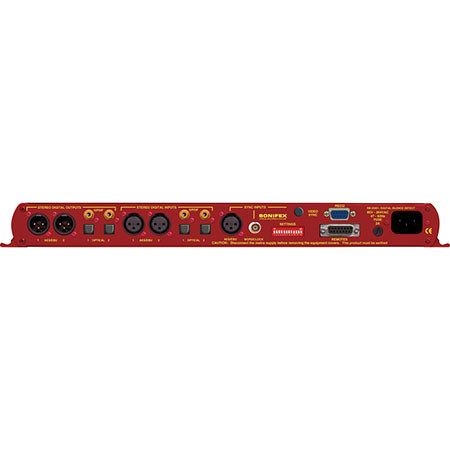
The Sonifex Redbox RB-DSD1 Digital Silence Detection Unit works in a similar way to the Sonifex RB-SD1 analogue silence detection unit, but has AES/EBU, S/PDIF and TOSlink inputs and outputs instead of analogue inputs and output respectively. Designed to switch from one input to another in the event of loss of audio, the unit is ideal at transmitter sites or after the master output of a studio, to switch in another audio source or simultaneous broadcast, should a master source fail. The unit can switch, on loss of level of the main input, on loss of level on one channel of the main input and on loss of synchronization lock of the main input.
The RB-DSD1 has 2 x digital stereo audio inputs, each one selectable via front panel MAIN and AUX push buttons, from either AES/EBU balanced XLRs, S/PDIF unbalanced phonos or TOSlink unbalanced optical inputs. Sample rate converters on each input mean that sources of different sample rates can be used with the output sample rate being defined independently. Each input is user-defined as either the main source or auxiliary source and both sources are monitored for failure, each having a remote failure alarm. The color of the MAIN and AUX push-buttons indicate which input is the main (green) and auxiliary (red) input, with a flashing LED indicating loss of synchronization.
In the event of the main source dropping below a pre-set level for a pre-determined amount of time, the unit will automatically switch through to the auxiliary signal. The silence detect level is adjustable between -39dBfs and -84dBfs in 3dBfs steps via front panel DIP switches. The silence interval can be adjusted between 0 seconds and 252 seconds in 2 second steps via another front panel DIP switch block. A small cover panel can be screwed in place to obscure the DIP switches to prevent tampering of the settings. There are 2 stereo outputs to allow for distribution of the selected input to multiple outputs. Each output is available as simultaneous AES/EBU balanced XLRs, S/PDIF unbalanced phonos or TOSlink unbalanced optical outputs. The output sample rates are selectable via rear panel DIP switches from one of 32kHz, 44.1kHz, 48kHz, 88.2kHz, 96kHz, 176.4kHz or 192kHz.
The unit has TTL word clock BNC and AES/EBU XLR synchronizing inputs as standard and optionally, the RB-SYA and RB-SYD synchronization boards can be fitted to synchronies the unit to analogue or digital video signals. A front panel DIP switch block is used to decide whether the unit is synchronized to Input 1, Input 2, the AES/EBU sync input, the word clock sync input or an optional video sync board. A front panel SYNC button selects the synchronization mode of the unit and the button flashes whenever the unit is not synchronized to an incoming sync signal.
Master Mode
In this mode the digital output sample rate is simply set by and locked to, the internal on-board clock generator. No sync signal is used or required.
Auto Sync Mode
In this mode the digital output sample rate follows the selected sync input. When the sync signal is not present the output sample rate will be set by and locked to, the internal on-board clock generator at the selected output frequency.
Auto Lock Mode
In this mode no output will be generated until lock is achieved with a sync signal. The digital output sample rate now follows the sync input. If the sync signal is removed then the output sample rate will be set by and locked to, the internal on-board clock generator at the closest frequency available to the previous sync input.
Slave Mode
In this mode the digital output sample rate follows the sync input. When the sync signal is not present the digital output is turned off. The unit can operate in 2 modes - automatic or manual, selectable using a rear panel DIP switch. In both modes it will automatically switch over to the auxiliary source on detecting silence. When the main signal is again detected it will either return to the main signal automatically or manually depending on the mode chosen. In manual mode, the front panel RESTORE button is used to return to the main signal.
The RB-DSD1 has a number of remote operational features. Remote outputs provide separate relay contact closures for failure of the main and auxiliary inputs. You can also remotely select between auto and manual mode (with tally output), action the signal RESTORE, set the silence detection delay to be 2mins 5 seconds and define which input is the main input (with tally output). You can remotely start and stop another piece of equipment on alarm failure and there is an option to set the remote start output as either momentary or latched.
The unit can be configured to alarm when either the left or right channel of the main input source fails or if the whole stereo signal fails. Additionally, if one channel of a stereo signal is lost, you can define whether to mute the lost channel or whether to mix the remaining channel to the lost side, effectively creating a mono signal. If the main source synchronization is lost, you can define whether the unit switches to the auxiliary input immediately or whether to treat the signal as silence to be detected and then switched based on the unit's silence detection settings.
Front panel LED indicators by the MAIN and AUX buttons show individually left and right programme and alarm conditions for both the main and auxiliary inputs. A powerful feature of the RB-DSD1 is that by using the Sonifex SCi serial software, the unit can be programmed for different delay durations, levels and switching functions so that you can programme the unit for your specific application. A front panel DIP switch configures the unit to be controlled serially and a front panel LED indicates serial operation. Contact Sonifex for further information if you have a particular requirement that isn't catered for by the RB-DSD1 as standard.
The RB-DSD1 has been designed to have a passive signal path through the main input, so if power to the unit fails, signal input 1 is routed to output 1 and signal input 2 is routed to output 2. This is essential for applications such as installation at transmitter sites, where a power failure to the unit should not prevent the audio input signal from being output to the transmitter.