See Options
Need help? Ask our experts.
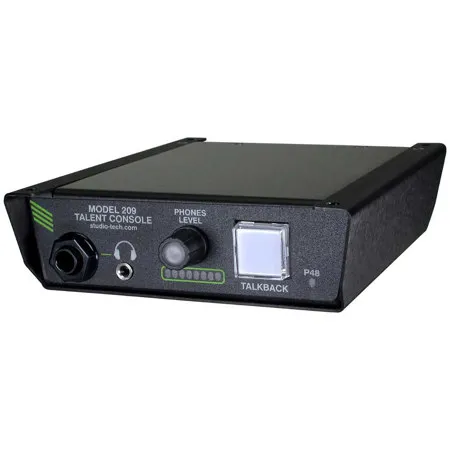
The Model 209 Talent Console offers a unique combination of audio, remote control, and tally-output resources for use in podcast and other specialized audio applications. The unit is housed in a compact enclosure that's intended for mounting under a tabletop, within custom furniture, or as part of an on-air set.
The Model 209 supports Dante audio-over-Ethernet digital media technology as well as AES67 for integration into contemporary applications. In addition, Audinate's Dante Domain Manager software application is supported.
The Model 209 is extremely simple to deploy, is "pro" quality throughout, and provides an intuitive user experience. The Model 209's audio quality is excellent, with low distortion, low noise, and high headroom. Careful circuit design and rugged components ensure long, reliable operation.
The Model 209 integrates directly into Dante audio-over-Ethernet environments. With just a Power over Ethernet (PoE) connection, a microphone, and a pair of headphones or an earpiece, a complete audio "position" can be created. In addition, remote control inputs and tally outputs allow the Model 209 to integrate directly into more complex applications.
A host of Model 209 features are configured using the STcontroller personal computer software application. This allows the unit's operation to be tailored to meet the exact needs of many installations. STcontroller is a fast and simple means of confirming and revising the unit's operating parameters.
Applications
The Model 209 can provide an "all-Dante" solution for one podcast location. A wide range of other applications can also be supported, including sports and entertainment TV and radio events, streaming broadcasts, corporate and government AV installations, and post-production facilities. The unit's capabilities allow it to be easily integrated into REMI/At-Home applications.
A high-performance microphone preamplifier and associated analog-to-digital circuitry routes the input audio signal to the Model 209's digital microcontroller integrated circuit. The audio quality compares very well to that provided by high-end external microphone preamplifiers, consoles, and I/O interfaces. A pushbutton switch provides the user with direct control over the microphone-associated audio signal as it is routed to the Dante main and talkback transmitter (output) audio channels. The audio switching is performed in the digital domain and is virtually "click-free." Two Dante receiver (input) audio channels supply the user with their talent cue signals. (Often referred to as IFB in broadcast applications.) Should the talent cue signal be "mix-minus" an integrated sidetone function can provide the user with a microphone confidence signal.
Remote control of a number of Model 209's functions can be easily performed. This is available in the form of two contact-closure inputs, by way of high-frequency tones that are embedded in the Dante receiver (input) audio channels, or using UDP commands supplied via Ethernet. Two tally outputs allow direct control of LED status arrays associated with the microphone mounting method. Using the Model 209 will often eliminate the need for an additional interface or LED control method.
Installation, Configuration, and Operation
Installation, configuration, and operation of the Model 209 is simple. The lightweight aluminum enclosure mounts under a tabletop or other work surface. On the unit's back panel an RJ45 jack is used to interconnect with a standard Ethernet port that supports Power over Ethernet (PoE). This connection provides both Model 209 power and bi-directional Dante digital audio. Also located on the unit's back panel is a 3-pin female XLR connector which allows connection of a dynamic, ribbon, or condenser microphone. The connected microphone can be a standalone "stick" type, a microphone associated with a broadcast headset, or a mic installed as part of a microphone mounting assembly. An integrated low-noise P48 phantom power source allows support for a wide range of professional condenser microphones.
Stereo or monaural headphones, headsets, or earpieces can be connected by way of the 1/4-inch and 3.5 mm 3-conductor jacks that are located on the Model 209's front panel. The headphone connections on the two jacks are connected in parallel ("multed"), providing the same 2-channel signal to various connected devices. The unit's two remote control inputs, accessible using a 3.5 mm 3-conductor jack, allow one or two contact closures to be connected. These contact closures can be configured to provide a remote version of the front-panel button function or to activate the tally output functions. Accessible on a separate 3.5 mm 3-conductor jack, two tally outputs provide DC signals to operate associated LED status indicators. The tally outputs are 12 volts DC and can provide up to 100 milliamperes of current. These robust outputs can function independently or as a single bi-directional current source to ensure compatibility with a range of microphone on/off status indicators.
The STcontroller software application is used to configure the Model 209's many operating parameters. This allows the unit's performance to be optimized to meet the needs of specific applications. Separate STcontroller versions are available, free of charge, to support personal computers running the Windows and macOS operating systems.
The user is presented with a simple set of controls and indicators. A lighted pushbutton switch is used to select the status of the microphone signal as it is sent to the Dante main and talkback transmitter (output) channels. A rotary level control, with internal RGB LED lighting, allows on/off control and level adjustment of the headphone output. An eight-LED multipurpose display provides a status indication of various Model 209 operating characteristics.
Ethernet Data and PoE
The Model 209 connects to a local area network (LAN) by way of a standard 100 Mb/s twisted-pair Ethernet interface. Two LEDs display the status of the network connection. The Model 209's operating power is provided by way of the Ethernet interface using the 802.3af Power over Ethernet (PoE) standard. This allows fast and efficient interconnection with an associated data network. To support PoE power management, the Model 209's PoE interface reports to the power sourcing equipment (PSE) that it's a class 2 (low power) device.
Dante Audio-over-Ethernet
Audio data is sent to and received from the Model 209 using the Dante audio-over-Ethernet media networking technology. As a Dante-compliant device, the Model 209's two Dante transmitter (output) and two Dante receiver (input) audio channels can be routed (subscribed) to other devices using the Dante Controller software application. The Dante transmitter and receiver channels are limited to supporting four Dante flows, two in each direction. The digital audio's bit depth is up to 32 with supported sample rates of 48 and 96 kHz. The Model 209 is compatible with the AES67 interoperability standard. In this mode, the two Dante transmitter (output) channels will function in multicast; unicast is not supported. In addition, the unit is compatible with the Dante Domain Manager (DDM) software application.
Audio Quality
The Model 209's audio performance is completely "pro." A low-noise, wide dynamic-range microphone preamplifier ensures that mic input audio quality is preserved while minimizing the chance of signal overload. The output of the microphone preamp is routed to a high-performance analog-to-digital conversion (ADC) section. The audio signal, now in the digital domain, routes through the unit's microcontroller integrated circuit and on to the Dante interface section where it is packetized and prepared for transport over Ethernet.
Audio input signals arrive via the Dante receiver (input) channels and pass into the Model 209's microcontroller integrated circuit. Channel routing, headphone level control, and sidetone creation are performed within the digital domain. This provides flexibility, allows precise control, and keeps the level control from having to directly handle analog audio signals. The two audio channels destined for the headphone outputs are sent to a high-performance digital-to-analog (DAC) integrated circuit and then on to robust driver circuitry. High signal levels can be provided to a variety of headsets, headphones, and earpieces.
Configuration Flexibility
The Model 209 can be configured to meet the needs of specific applications and user-preferences. All configuration choices are performed using the STcontroller personal computer software application which is available free of charge on the Studio Technologies' website. There are no mechanical switch settings or button-press sequences required to configure how the unit functions. Selectable parameters include P48 phantom power on/off, microphone preamplifier gain, headphone and sidetone operation, talkback button operation, level display, remote control inputs, and tally outputs.
Microphone Input and Audio Outputs
The gain of the microphone preamplifier can be selected over a range of 20 to 65 dB in single dB steps. This allows the Model 209 to match the output sensitivity of a range of standalone and headset-associated microphones. A low-noise source of P48 phantom power can be enabled, if required, to support a variety of condenser microphones.
The talkback pushbutton switch, located on the Model 209's front panel, can be configured from among five operating modes. These choices allow the Model 209's audio output operation to be tailored to meet the specific needs of the application. As an example, for a podcast application the pushbutton would typically be configured to provide a push to mute (cough) function.