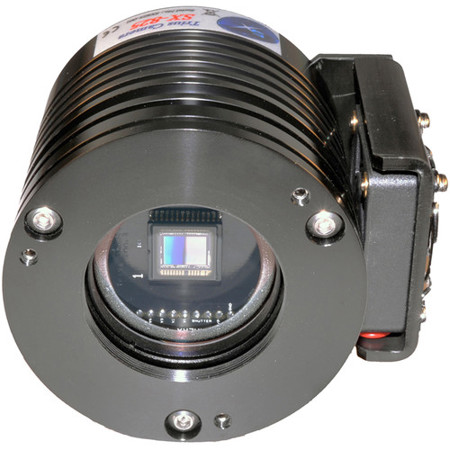
Starlight Xpress Trius SX-825 Monochrome CCD Camera, USB 2.0, 6.45x6.45uM Pixel Size, 1392x1040 Pixel Image Format
SKU: SXTSX825
This item is no longer available.
Share:
Overview
Compare
Specs
Protection







About Starlight Xpress Trius SX-825
The TRIUS SX-825 is an advanced, high resolution, cooled CCD camera, especially designed for astronomical imaging. It uses a second generation version of the very popular Sony 'EXview II' CCDs that offer very high QE and extremely low thermal noise. It is a substantial upgrade on the SXVR camera range and incorporates several new features, such as an internal USB hub with 3 external ports and a dry argon CCD chamber fill. The USB hub permits several other devices to share the single USB connection and greatly reduces the number of cables required in a typical set-up.
For example, a Lodestar or Superstar guide camera and an SX filter wheel could use two of the USB ports and the third might connect to an electric focuser or similar peripheral. The argon fill, along with other improvements to the cooler stack, has improved the delta T to about -42 degrees C. As per the SXVR range, this camera also includes a CCD temperature monitoring circuit that provides regulated set-point cooling of the chip, adjustable chip alignment and a very compact overall size.
The TRIUS SX-825 uses a Sony ICX825AL 'EXview II' progressive scan CCD, with 1392 x 1040 x 6.45uM pixels in a 8.8 x 6.3mm active area. This EXview II device has an excellent quantum efficiency, with a broad spectral response peaking at around 77% in yellow light and an extremely low dark current, well below that of any comparable CCD currently available. While this device also has an excellent blue light sensitivity, it has a strong infra-red response, which makes it ideal for all aspects of both planetary and deep-sky imaging, especially with an H-alpha filter. The H-alpha QE is about 65%, considerably better than other interline chips and even greater than the popular KAF8300 CCD. The full-frame download time is approximately 4 seconds and a binned 4x4 download takes only 0.5 seconds, so finding and centering are very quick and easy in this mode.
You will also need a PC computer with Windows XP, Vista or Windows 7 installed. This machine must have at least one USB 2.0 port available and at least 256 Mbytes of memory. If you intend to view the finished images on its screen, then you will also need a graphics card capable of displaying an image with a minimum of 1024 x 768 pixels and 24 bit color. A medium specification Pentium with between 1GHz and 4GHz processor speed is ideal, but I recommend avoiding some of the lower specification 'Netbook' computers, as they can't really handle the fast data stream from the camera. Please note that USB 2.0 operates at a very high speed and cannot operate over very long cables. Five meters of good quality cable is the maximum normally possible without boosters or extra powered hubs, although you can sometimes get good results at longer distances with very high quality cables.
Other features of the TRIUS SX-825 hardware and software
'Slew & Sum' imaging
The TRIUS SX-825 can be used in an automatic image-stacking mode, called 'Slew & Sum'. The camera is set to take several sequential exposures, which are automatically 'slewed' into alignment and then summed together by the software. This mode can help to overcome a poor RA drive by summing images that have exposure times shorter than the drive error period. The resulting image has more noise than a single exposure of the same total length, but this method of imaging is still an effective way of making long exposures without a guider.
To take an S&S image, go to the camera interface window and select an exposure time for one image of the sequence. Do not use a very short exposure time, as the read-out noise will become dominant. About 30 seconds is a reasonable minimum. Now go to the 'Multiple Exposure Options' and select a number of exposures to take. You can also select to average the images, rather than adding them and there is a 'Alternative Slew Mode' available, which uses the correlation of image areas, rather than a single star. This mode can be better in dense star fields.
Another option is 'Auto remove dark frame'. This is advisable with S&S images, as the slewing will mis-register the images with a single dark frame that is applied to the finished sequence. To use this option, you will need a dark frame, taken with the same exposure time as a single image from the sequence. This is stored on drive C with the name 'dark.def' Now click on 'Take Picture' and the sequence will begin.
Using the 'Binned' modes
Up to this point, I have assumed that the full resolution, imaging mode is being used. This is fine for most purposes, but it will often provide more resolution than the optical system or the seeing, allows. 'Binned 2x2' mode sums groups of 4 pixels into one output pixel, thus creating a pixel image with 4 times the effective sensitivity. Using 2x2 binning, you can considerably improve the sensitivity of the TRIUS SX-825 without losing a great deal of resolving power, so you may like to use this mode for many faint deep-sky objects. Other binning modes (3x3 and 4x4) are available and will further increase the image brightness and reduce its resolution. However, generally, these are more useful for finding faint objects, than for imaging.
Taking and using a flat field
Flat fields are images, which display only the variations of illumination and sensitivity of the CCD and are used to mathematically modify a wanted image in such a way that the errors are removed. Common flat field errors are due to dust motes on the camera window and vignetting effects in the optical system of the telescope. Dust motes act as 'inverse pinholes' and cast out-of-focus images of the telescope aperture onto the CCD chip, where they appear as shadow 'do-nuts'. Most optical systems show some vignetting at the edges of the field, especially when focal reducers are used. This causes a brighter center to show in images, especially when there is a lot of sky light to illuminate the field.
If dust motes are your main problem, it is best to clean the camera window, rather than to rely on a flat field to remove the do-nuts. Flat fields always increase the noise in an image and so physical dust removal is the best option. If you have serious vignetting, first check whether the optical system can be improved. The most likely cause of this problem is trying to use too powerful a degree of optical compression with a focal reducer and you might want to try moving the camera closer to the reducer lens.