

See Options
Need help? Ask our experts.
Review Summary
2019-02-12T07:41:25
My lens is stuck to the adaptor. Nice having a ND filter inside of the adaptor bc my 14mm doesn’t have a thread for filters. However having it stuck to the adaptor only limits me to using on the Sony now. Annoying.
CHERIE K.
2018-11-17T03:14:09
I didn’t received the same model shown on the pictures but overall it’s pretty solid and great quality, i like the smoothness of the ring.
VLADIMIR A.
2018-06-13T06:13:05
I wish more of this information was available in the product description, but I guess not 0.o haha. Anyways this can be a great adapter depending on the lens youre looking to use with it. if you don't need to play around with aperture and your lens in 35mm or narrower then its fantastic! if youre wider than 35mm then youll get some vignetting, and you also cannot set the ND to 0 so its flexibility as an adapter is compromised to say the least (youll be losing about a half stop always) this wouldve been perfect for me if I wasnt trying to use a 30mm lens on it so Im going to be returning it. OH! and this model in the picture isn't the one you'll recieve, the ring has been updated to be more tactile.
Jocelyn A.
All Sony E-mount Camera Bodies, Including but not limited to:
Sony ILCE-7, ILCE-7R and ILCE-7S (a7 / a7R / a7S)
Sony NEX-3, NEX-5, NEX-C3, NEX-5N, NEX-7, NEX-F3, NEX-5R, NEX-6
Sony NEX-VG10, NEX-VG20, NEX-VG30, NEX-VG900, NEX-FS100, NEX-FS700, NEX-EA50
Canon EOS Mount Lenses to Sony Alpha E-Mount Camera
ND2 - ND1000 (1 - 10 stops)
Yes
Brass with Stainless Steel Finish
Stop-Down / Manual
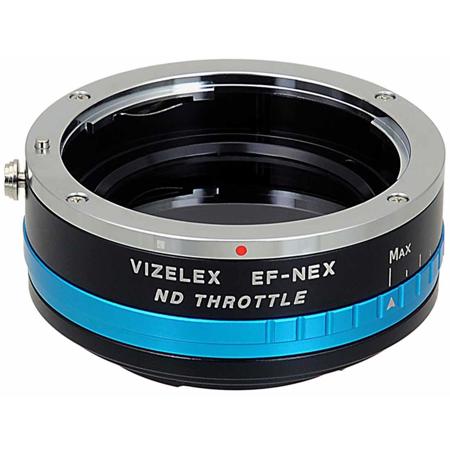
Fotodiox lens mount adapter with a built-in Variable ND filter. The ND Throttle opens up new creative possibilities, like long exposure and shallow depth of field, even in bright conditions. No more carrying around a camera bag full of ND filters. Built-in variable ND means easy and convenient image control over any lens that you attach - even wide angle lenses that don't work with front-mounted variable ND filters.
This is a manual adapter, so lens functions that rely on electronic communication with the camera body (autofocus, AE metering, image stabilization, etc.) will be disrupted.
Set your exposure manually or meter using your camera's Aperture Priority (stop-down) mode.
If your lens does not have a manual aperture control ring, it will stop down to its smallest f/stop by default.