+3
more
more

Need help? Ask our experts.
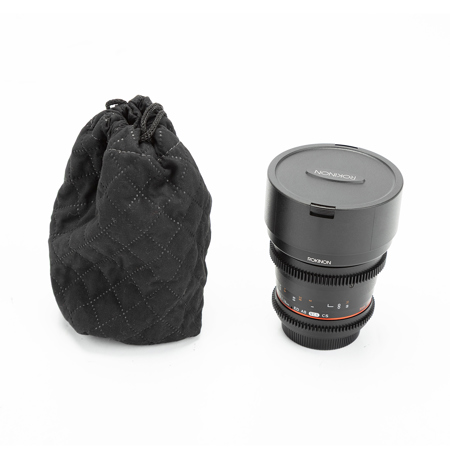
The Rokinon 10mm T3.1 Cine Wide Angle Lens for Canon EF Mount is a wide-angle lens optimized for digital cinematography. The lens produces an image circle that will cover APS-C sized sensors or smaller. For use with a follow focus unit, the focus and aperture rings feature industry-standard 0.8 pitch gearing. The aperture ring is also de-clicked to allow for smooth iris pulls while shooting. Focus, aperture and depth of field markings are on the side of the lens to aid focus pullers, who typically operates on the side of the camera.
With an angle of view of 105.9deg., the lens is well-suited for shooting landscapes, architecture and for use in tight interior locations. One extra-low dispersion element (ED) and two aspherical elements have been incorporated into the optical design to minimize chromatic aberrations and distortion in order to produce sharper images. Additionally, a Nano Coating System (NCS) has been applied to the lens elements in order to reduce surface reflections and prevent lens flare and ghosting for improved light transmission and more contrast-rich imagery.