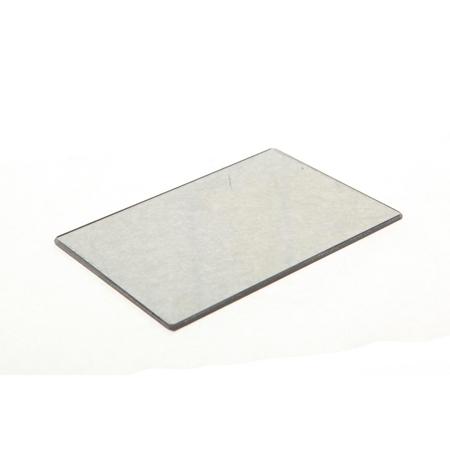
About Tiffen 4x5.65" Graduated Neutral Density ND 0.3 Water White Glass Filter, Soft Edge, Vertical Orientation
The Tiffen 4 x 5.65" Graduated Neutral Density (ND) ND 0.3 Water White Glass Filter enables the shooter to adjust exposure without affecting color balance. Neutral density filter is available in 1, 2, 3, or 4 stops to suit individual situations.
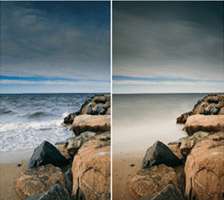
Often it is necessary or desirable to balance the light intensity in one part of a scene with another. This is especially true in situations where you don't have total light control, as in bright contrast landscapes. Exposing for the foreground will produce a washed-out, over-exposed sky while exposing for the sky will leave the foreground dark and under-exposed. This filter enables cloud detail to be kept correctly exposed in the picture.
Determining which graduated neutral density filter yields ideal results for any given lighting situation takes knowledge, experience and a collection of such filters. Choose the filter strength which adjusts the lighting to stay within the exposure latitude (greatest difference between bright/dark values) which still shows details in both of the digital or film medium in use.
Speaking generally, the 2-stop value (ND 0.6 - the filter's clear portion allows 4x more light to pass vs. darkest portion) effectively compensates average bright sky-to-foreground situations and the soft transition is applicable more often to a scene than the hard transition. The Soft label indicates the degree of color graduation. The Vertical indicates the direction of the graduation.
Tiffen 4x5.65" Graduated Neutral Density ND 0.3 Water White Glass Filter, Soft Edge, Vertical Orientation Features
To enable slow shutter speeds to be used, especially with high speed films, to record movement in subjects such as waterfalls, clouds, or cars
To decrease depth of field by allowing wider apertures to be used, which helps separate subjects from their background
To decrease the effective ISO of high speed film (above ISO 400) and allow it to be used outdoors in bright situations
To allow cine and video cameras (which have fixed shutter speeds) to film subjects such as snow, sand or other bright scenes which could cause overexposure
Tiffen filter is manufactured using ColorCore technology, closely guarded proprietary process that entails permanently laminating the filter material in between two pieces of optical glass that are ground flat to tolerances of a ten-thousandth of an inch, then mounting them in precision metal rings
The ColorCore process allows Tiffen to control the color and density of this filter and the characteristics of special effects filters with much greater accuracy than typical dyed-in-the-mass filters, which usually exhibit color and density variations
Top Hollywood motion picture studios rely on Tiffen filter for that multimillion-dollar productions Superior quality and design make Tiffen the overwhelming choice of moviemakers, professional photographers and even NASA
Tiffen has also been awarded an Emmy, from the Academy of Television Arts and Sciences, for its engineering excellence