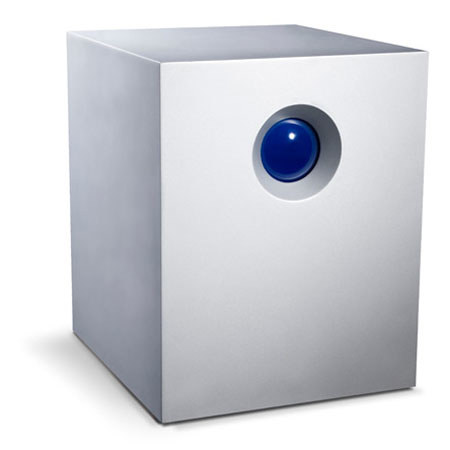
About LaCie 4Big Quadra USB 16TB RAID
The Lacie 4Big Quadra USB 3.0 16TB Raid Hard Drive is a hard drive solution designed with the professional in mind. This 16TB drive offers a variety of connectivity options including one USB 3.0 port and two FireWire 800 ports. The USB 3.0 connectivity option provides data transfer rates of up to 5Gb/s while the FireWire 800 port transfers data at speeds up to 800Mb/s. These versatile connection options make it easy to integrate this hard drive into a current desktop or server configuration. The four included hard drives are hot-swappable making it easy to swap out drives without shutting down your system.
This 4big Quadra Drive comes equipped with the ability to operate in a variety of RAID configurations. RAID, or redundant array of independent disks, is a storage technology that combines multiple disk drive components into a logical unit. The included RAID configurations are RAID 0, RAID 5, RAID 5+Spare, RAID 3, RAID 3+Spare, Concatenation and RAID 10. Each of these configurations makes it possible to configure the drives by dividing and replicating the data among multiple physical drives giving you the ability to achieve a variety of goals such as drive availability, performance and capacity.
LaCie 4Big Quadra USB 16TB RAID Features
Enhanced Speed Through USB 3.0: With USB 3.0 connectivity, the LaCie 4big Quadra delivers optimized performance for PCs and late-model Macs. Its four 7200RPM professional hard disks configured in RAID 0 provide up to 245MB/s
Universal Connectivity for Compatibility: With its multiple interfaces, the LaCie 4big Quadra is the perfect match for any Mac or PC. With FireWire 800, import your data from your old computer even faster, if your old computer is compatible
Comprehensive Data Protection: The LaCie 4big Quadra can be configured in RAID 5 so your data is kept safe even if a drive fails, without compromising performance. Thanks to hot-swappable drives, you can simply swap in a new disk without switching off the device
Dual Cooling System for Long-Term Reliability: The LaCie 4big Quadra's advanced dual cooling system ensures long-term reliability by preventing overheating. The system consists of three key components: an innovative heat-dissipating aluminum casing, a Noctua cooling fan and jumbo heat exhausts
Designed for Convenience: With a small footprint and space-saving design, you can stand it alone or stack multiple LaCie 4bigs. With the ability to setup email alerts, the device can be closely monitored for potential problems