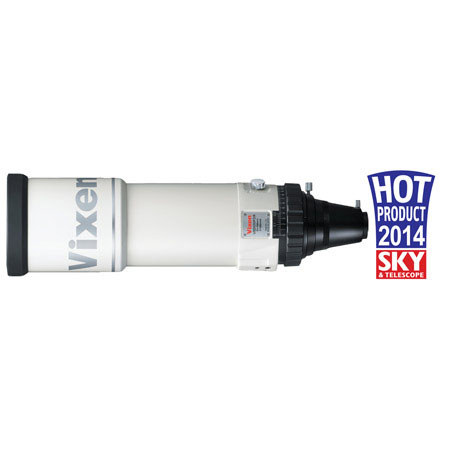
About Vixen VSD 100
The Vixen VSD100F3.8 features a surprisingly fast f-ratio of F/3.8 which is the fastest in this class of quality refractors, a truly wide and flat imaging field that covers 645 medium format cameras and an innovative 5 elements in 5 group lens design which eliminates a violet tint in chromatic aberration (blue halo) to the ultimate.
It employs a SD lens in the front objective group and an ED lens in the rear objective group to achieve a superb color correction. The blue halos around stars, that are perceptible in astrophotography and that is hard to depress with a 4 elements in 4 group lens design, are corrected successfully. In addition, astigmatism and coma aberrations are corrected in an extremely high level of image quality.
The Strehl intensity on the lens design of the VSD100F3.8 is better than that on the 4 elements in 4 group lens design by 10% approximately. It does not drop abruptly as stars are away from the center of a photographic field. It is suitable excellently to detect faint stars. The image circle is as large as 70mm in diameter (60% illuminated). The star images are as small as about 15 microns around the corners resulting in excellent field flatness.
The VSD100F3.8 applies the most up-to-date coatings of extremely high reflectivity that are developed to match the characteristics of each lens element in order to avoid the deterioration of image contrast due to the increase of lens elements. It boasts of a 99.9% light transmiss ion at the maximum per lens surface and achieves superb images with extremely high contrast with no ghost and no flare images. (Patent pending)
Vixen has started a new project in each stage of their manufacturing process for better quality to materialize the high performance as designed. In the process of manufacturing optical glass, all the five lens elements are annealed with a precision annealing process (The annealing can straighten molecular arrangements of lens elements and thus unify the characteristic of optical glass.) and the homogeneity of refractivity in optical glass is enhanced to the highest.
Vixen VSD 100 Features
Precision Glass Annealing Process: all the five lens elements are annealed with a precision annealing process and the homogeneity of refractivity in optical glass is enhanced to the highest standards.
Premium Zygo Verifier ATZ Laser Interferometer: The Zygo Verifier ATZ has a 1000 x 1000 pixel digital camera for high resolution metrology that can catch accurately a steep change of a form on the optical surface of lenses. It can provide an in-depth control of the lens quality which was only dreamed before.
Precision Over-sized Focuser: The VSD100F3.8 has an oversized focuser that can be attached the 645 medium format cameras without difficulty. Highly accurate focusing is possible with the non-rotational helical fine focuser, where an amount of drawing in and out the focuser can be read as small as 20 microns with the provided vernier scale.
Large Rubber Focus Ring: The grooved large rubber focusing ring can be grasped easily with hands wearing gloves in the cold season. The thick rubber ring on the top of the dew shield absorbs a shock and protects the optics.
Stopper Piece: The stopper piece inside the helical fine focuser has a slot for smooth focusing movements without slack. It assists to have the large rubber focus ring turned smoothly in the cold season with a large CCD camera attached.
Dew Shield: The length of the dew shield, the positions of the inner baffles and their proportions to the diameter of the optical tube has been examined in cooperation with the analysis of eliminating ghost in the process of the lens design to prevent from stray light and a generation of flare successfully.
Optional Focal Reducer and Optional Tele-Extender (not included): A focal reducer (0.79x) with the optical design of 3 elements in 3 groups and a tele-extender (1.58x) with the optical design of 4 elements in 3 groups will be available as optional parts.
Optional Focal Reducer and Optional Tele-Extender (not included): With the use of these optional accessories, the VSD100F3.8 can be transformed to an ultra fast astrograph with 300mm in focal length at F3.0, or can be converted a versatile optical tube with 600mm in focal length at F6.0 for observing planets and other celestial objects.