+1
more
more

See Options
Need help? Ask our experts.
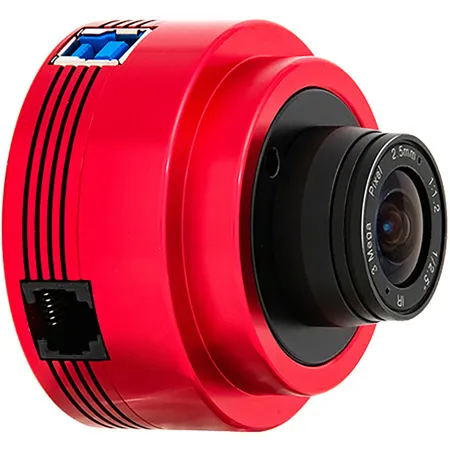
Planetary Camera with High NIR Sensitivity
ASI678MC incorporates Sony's latest generation sensor IMX678 with outstanding near-infrared response. Featuring large full well capacity, high dynamic range, and low readout noise, this camera has demonstrated impeccable performance in planetary imaging, as well as solar and lunar imaging.
Clear in Low Light
Thanks to the back-illuminated 4K CMOS image sensor, this camera has excellent sensitivity in the near-infrared spectrum. When matching with an 850nm IR-Pass filter or an 890nm methane filter, it can capture great infrared images of Jupiter and Saturn.
• 1/1.8"
• 2microm
• Back-illuminated
STARVIS 2
STARVIS is a sensor technology developed by Sony that surpasses the sensitivity of the human eye. STARVIS 2 is an advancement of STARVIS technology, supporting even higher dynamic range.
Featuring this technology, the ASI678MM/MC astronomical camera exhibits lower readout noise and dark current, along with significantly enhanced sensitivity in the near-infrared spectrum.
256MB DDR3
The camera is equipped with a USB 3.0 transmission interface and a built-in 256MB DDR3 cache to ensure stable and secure data transmission. Under long exposure, it effectively avoids frame dropping and greatly reduces the glow effect caused by slow reading speed.
No Amp Glow
ASI678MC does not have any amp glow, no matter how long the exposure and how high the gain value you set.
Note: This technology is implemented directly at the hardware level, it does not require software control
HCG Mode
The camera has a built-in HCG mode, which can effectively reduce readout noise at high gain. This allows the camera to maintain the same high dynamic range as it does at low gain. When the gain is 182, the HCG mode is automatically turned on. The readout noise is as low as 0.8e, and the dynamic range can still reach a level close to 11stops.
Quantum Efficiency
The QE curve and readout noise are very important parameters to measure the camera's performance. Higher OE and lower readout noise are necessary to improve the image signal-to-noise ratio.
Dark Current Noise
ASI678MC has much lower dark current noises than ASI178, bringing it better image signal-to-noise ratios. If we compare the dark frames captured with these two cameras, it can be easily found that the frame from AS1678 has much less noise and looks much smoother.