



Need help? Ask our experts.
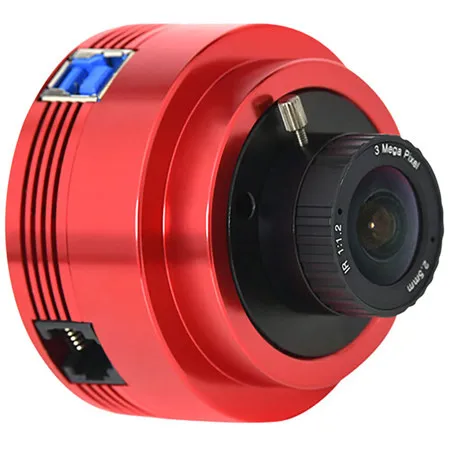
ASI664MC is a remarkable new planetary CMOS camera. The 1/1.8" Sony IMX664 sensor features a small pixel size of 2.9microns pixel and a high resolution of 2704x1536(4.15MP). In high-speed mode, the frame rate reaches 95fps, while the readout noise remains at a low level, as low as 0.46e!
The larger sensor size and higher resolution compared with ASI662MC result in sharper images for a better astrophotography experience.
STARVIS 2 Technology
You might not be strange with Sony STARVIS 2 technology. It offers ASI664MC outstanding image quality and imaging performance.
High Transmission Speed
This camera has a USB 3.0 interface, along with the built-in 256MB DDR3 cache, ensuring high-speed, smooth and stable data transmission.
Zero Amp Glow
ASI664MC adopts no-glow circuity to avoid the annoying amp glow being produced, and ensure the image quality no matter how long the exposure and how high the gain value is.
Camera Curve
Low readout noise, high dynamic range
The camera has a built-in HCG mode, which can effectively reduce readout noise at high gain and keep the dynamic range at the same level as it does at low gain. At gain 252 and above, the HCG mode is automatically turned on; the dynamic range is close to 11bit; the readout noise can be lower than 1.0e.
Quantum Efficiency
QE curve and readout noise are very important parameters to measure the camera's performance. Higher QE and lower readout noise are necessary to improve the image signal-to-noise ratio. According to our estimation, the QE peak value of ASI664MC is about 91%.
Protective Window
ASI664MC adopts an AR-coated filter as the protective window (Diameter: 21mm, thickness: 1.1mm). It improves the camera's performance in UV and NIR wavelengths.
