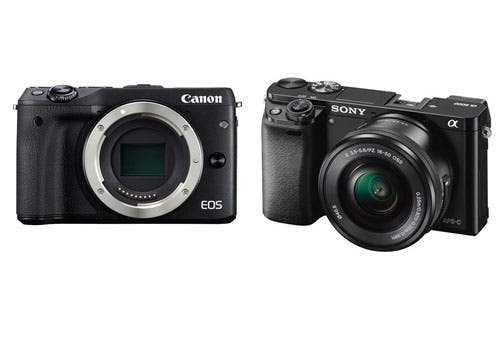
The latest crop of mirrorless interchangeable-lens cameras can deliver the complete DSLR shooting experience and then some. And these increasingly popular cameras come in smaller, lighter form factors that appeal to a wide variety of shooters ranging from emerging enthusiasts, travelers, and women, to seasoned pros. Indeed, some industry experts have predicted that mirrorless System Cameras will eventually supplant DSLRs, which are inherently larger, heavier, and more complex, for all but high-end professional users. The technological reasons behind this accelerating trend have been the significant advances in two key mirrorless components: the electronic viewfinder (EVF), and the autofocus (AF) system. And while current EVFs may not quite equal the “natural” view provided by the best optical DSLR viewfinders, they’ve come so far that the differences may no longer be significant to most users.
Should you ditch your DSLR?
Does this mean, as one recent mirrorless ad campaign provocatively put it, that you should “Ditch the DSLR?” Let’s just say that there are many good reasons not to, especially if you like the DSLR you now own and it’s performing very well for the kind of photography you do now and intend to pursue going forward. And if you have a bunch of lenses for it, it may make more sense to upgrade to the latest DSLR in the maker’s lineup than to invest in a whole new mirrorless system. Indeed, there are many reasons that pros using top-tier DSLRs fitted with premium lenses often prefer to stick with what works than to venture into uncharted waters. Having said all that it’s clear that an increasing number of pros and serious enthusiasts are now acquiring mirrorless cameras whether they retain their present DSLRs or not, and at this point, it’s fair to say that the upside potential of the mirrorless market is greater than that of traditional DSLRS. If you’re on the fence, or considering buying a new interchangeable lens camera here’s a quick rundown of the pros and cons of each type that should help you make intelligent choices.
Mirrorless Camera Pros
- Mirrorless cameras, regardless of format, are almost always smaller and lighter than comparable DSLRs because they don’t require a relatively bulky, heavy mirror box and the mechanisms needed to move a reflex mirror into and out of the light path. As a result, they have fewer moving parts, are quieter in operation than traditional DSLRs, and are inherently less prone to causing shake-inducing vibration.
- Today’s top mirrorless cameras incorporate high resolution EVFs or OLED EVFs with incredibly rapid refresh rates (60 times per sec and up) that provide a brilliant, 100% coverage, high-magnification, eye level viewing image that rivals that of most optical viewfinders (OVFs), and provide continuous viewing without momentary finder blackout even as the shutter fires.
- The EVFs in mirrorless cameras have the advantage of allowing users to preview the captured (complete with exposure corrections and custom settings) in real time. This makes it easier, for example, to compose subjects in very dim light because the gain is automatically increased to make them more visible.
- Mirrorless cameras typically include Hybrid AF systems that combine the advantages of fast, decisive on-sensor phase-detection AF (PDAF) and the precision of contrast-detect AF (CAF), taking their AF performance to a level surpassing that of all but top-tier DSLRs.
- Further advantages of the hybrid CAF/PDAF systems in mirrorless cameras include the ability to provide continuous AF and focus tracking before and during the exposure, a crucial factor when shooting still images at high burst rates, or capturing clean HD video without visible or audible “hunting.”
- Mirrorless cameras enable the layering of viewfinder information, such as camera settings, levels, histograms, focus peaking, etc., and can also provide an instant magnified image of the focusing area and allow playback of images and videos in the EVF.
- Mirrorless cameras allow the seamless use of existing “open source” lenses by using simple mount adapters to expand the camera’s optical array. The possibilities include mounting lenses from other lens systems, classic rangefinder lenses, and lenses from obsolete or obscure systems.
- The shorter flange back (mount to sensor) distance of mirrorless cameras makes it easier to design high-quality lenses, particularly wide-angles, that provide better edge and corner illumination and greater light transmission efficiency.
- The Hybrid AF systems in mirrorless cameras cover a wider area of the sensor, providing AF capability closer to the edges and corners of the frame, and enhancing overall AF flexibility.
- Mirrorless cameras provide continuous Live View via the LCD or EVF and provide previewing using either viewing system when shooting video, with no loss of AF capability.
At their best, mirrorless system cameras combine the advantages of both DSLRs and point-and-shoots, providing lens interchangeability, ultra-high image quality, and the entire high-end feature array of middle- and upper-tier DSLRs in smaller, lighter, handier form factors. Not surprisingly, as the popularity of MSC’s has dramatically increased over the past 2 years or so, camera makers and independent lens manufacturers have vastly expanded their lens offerings, vastly increasing the creative optical options available to consumers, and marketing opportunities for dealers.
The MSC market continues to be technologically driven, with many of the latest high-end models offering higher-res sensors, enhanced image-processing software for greater responsiveness, faster burst rates, 4K video capture, full Wi-Fi connectivity and GPS, multi-axis in-body image stabilization, and enhanced viewing options such as hi-res tilt/swing and touch screen LCDs, and OLED EVFs. However, entry-level and middle-tier MSCs have also benefitted from these technological advances. The result is an array of enticing new models offering features that have migrated down from higher-end models, often with simplified user interfaces, and at very competitive prices.
DSLR Pros
- Middle- and upper-tier pro models with solid glass pentaprism optical viewfinders, provide a brilliant “real feel” viewing image that no mirrorless EVF can quite match. Whether this is important to you is, of course, subjective, but many photographers accustomed to optical viewfinders consider it a definite plus.
- Digital SLRs are generally larger than mirrorless cameras and this allows more room for the placement of dedicated controls for various camera functions such as ISO, exposure compensation, white balance, etc. The control ergonomics of the best DSLRs often have an edge over their current mirrorless counterparts in this respect.
- Theuse of larger batteriesprovides greater capacity than smaller batteries. With most pro-caliber DSLRs you can shoot all day without running out of battery power, and that’s not always true with comparable mirrorless cameras.
- Photographers with large hands often prefer DSLRs.DSLRs have evolved into a very ergonomic shape and some of them are more comfortably contoured than their mirrorless counterparts. Some shooters feel that a heavier camera, like the DSLR, alsoprovides a more stable shooting platform than some of the smaller, lighter mirrorless cameras. Again this is subjective and the decision is personal.
- It’s hard to beat the record of durability, reliability, and consistent performance under adverse conditions of a DSLR. Additionally, DSLRS offerin-body or on-lens image stabilization systems to minimize the effects of mirror-induced camera shake. That’s why many pros are reluctant to make the switch.
- DSLRs offer very well developed lens systems that include numerous professional prime and zoom lenses that deliver spectacular imaging performance. While mirrorless systems have yet to match the phenomenal optical arrays available for the leading DSLR systems, this will happen sooner rather than later as both camera makers and independent lens makers are rapidly expanding and upgrading their optical offerings.
Unquestionably both traditional DSLRs and mirrorless cameras are the heart of supremely versatile, viable systems capable of the highest levels of imaging performance. While we hope it helps to enumerate the advantages of each, the choice is inherently subjective, and a lot depends on what equipment you have now and in what direction you want to take your creative photography. As they say, it’s up to you, but the current crop of cameras of each type deliver awesome performance, and whatever you decide you’re not likely to be disappointed.
Mirrorless Cameras to Check Out:
Leica SL (Typ 601) Mirrorless Digital Camera: A professional camera of the highest caliber, this “next generation” L-mount Leica delivers cutting-edge features and specs in Leica’s classic Leica rounded-edge ergonomic form factor. It incorporates a 24MP full-frame CMOS sensor coupled to Leica’s in-house Maestro II image processor to deliver outstanding image quality at sensitivities ranging from ISO 50-50000. To maximize resolution and detail, the sensor foregoes the use of a low-pass filter, and to meet the needs of demanding video-shooting pros, the SL provides DCI 4K (4096 x 2160) video recording at 24 fps in Super35 mode along with the L-Log gamma to maximize dynamic range. It can also capture UHD (3840 x 2160) video at 30 and 25 fps, delivers a full-res burst rate of 11 fps, and has a 2GB internal buffer that allows bursts of up to 33 DNG files or unlimited JPEGs. Other key features: A 4.4MP ultra-hi-res 0.66-inch 0.8x-magnification EVF, a 2.95-inch 1.04m-dot rear LED touchscreen with a wide, 170-degree field of view, a super-fast, ultra-precise, multi-option Contrast AF system with Touch AF setting, Dual SD Card Slots, and built-in Wi-Fi and GPS. Made in Germany the SL’s weather resistant body is crafted from two blocks of solid aluminum. Adorama price: $7,450.00, body only.
Canon EOS M10: Canon’s compact, classically styled broad-spectrum mirrorless entry features an 18.0MP APS-C-format CMOS sensor coupled to an advanced DIGIC-6 image processor that enables ISO settings of 100-12800 expandable to ISO 25600, a continuous full-res burst rate of 4.6 fps, Full HD 1080p video capture at 30 and 24 fps, and a Hybrid CMOS AF-II AF system that’s impressively fast and precise. Other features: A 3.0-inch, 1.04m-dot 180-degree-tilting touchscreen LCD to facilitate selfies, built in Wi-Fi with NFC, Creative Assist mode, Picture Style settings, and 7 built-in Creative Filters including Fisheye Effect. The standard 15-45mm (24-72mm equivalent) EF-M-mount STM lens includes a nearly silent stepping motor optimized for video, a built-in Optical Stabilizer that minimizes the effects of camera shake, and 3 aspheric elements for enhanced imaging performance over its entire range: Adorama price: $449.00 in black or white with Canon EF-M 15-45mm f/3.5-5.6 IS STM lens.
Sony Alpha A7 II: The latest addition to the Alpha A7 line of high-performance, full-frame compact mirrorless system cameras is the first to feature sensor-shifting 5-Axis SteadyShot INSIDE image stabilization providing a claimed 4.5 stops of anti-shake compensation for pitch, yaw, horizontal and vertical shift, and roll—a big plus when shooting Full HD 1080p video at 60p, 30p and 24p using the high-bit-rate XAVC S format, or handheld stills in low light. The a7II employs a 24.3MP Exmor CMOS sensor coupled to an advance BIONZ Z image processor and uses an Enhanced Fast Hybrid AF system with 117 phase-detect and 25 contrast-detect sensors on the image sensor, claimed to provide superior focus tracking and a full-res burst rate of up to 5 fps with continuous AF and AE. Other key features include a 3.0-inch 1,228.8-dot tilting LCD monitor, a 0.5-inch 2.36M-dot XGA OLED Tru-Finder EVF, customizable color and gamma controls including the same S-Log2 Gamma Curve found on high-end Sony cinema cameras for increased dynamic range, built-in Wi-Fi with NFC, a redesigned ergonomic grip, shutter release and controls, and magnesium alloy body construction. Adorama price: $1,998.00 with Sony FE 28-70mm f/3.5-5.6 OSS lens.
Traditional DSLRs to check out
Pentax K-3 II: This latest top-of-the-line K-3 takes the classic Pentax K line to a higher level with an upgraded 24.35MP APS-C-format CMOS sensor, an Anti-Aliasing Filter Simulator that give users the choice of leaving it off for superior resolution and detail capture, or turning it on to eliminate moiré patterns, and an advanced Prime III Image Processor for enhanced speed and performance. Other significant enthusiast-aimed upgrades: A new SAFOX AE/AF system with 27 cross-type AF points and an 86K RGB AE sensor that provides superior subject identification to enhance AF accuracy, an 8.3 fps maximum full-res burst rate, multi-pattern auto white balance (AWB), dual SD card slots, and a new larger 3.2 inch 1037k LCD, and a built-in GPS module, electronic compass, and AstroTracer for better night sky images. The built-in sensor-based Shake Reduction (SR) system is now said to provide a 4.5-stop advantage in handheld shooting. Support for smart phones and PCs connectivity is included and remote shutter release, viewing, and importing images are possible with a Pentax Edition FLU card. Retained legacy features include a top shutter speed of 1/8000 sec, full HD 1080p video with external mike jack, HDMI output for stills, video, and sound, and a fully sealed, weather resistant magnesium alloy body. Adorama price: $729.00, body only.
Canon EOS 5DS R: Delivering the full resolving power of its remarkable new 50.6 MP full-frame sensor by cancelling the negative effects of the low-pass filter, the pro-aimed 5DS R is capable of delivering medium-format-level ultra-hi-res images and also offers HD 1080p video at 30 fps plus a Time Lapse movie function that combines images shot at set intervals into a full GD movie. Other high-end features include Dual DIGIC 6 image processors, a big 3.2-inch 1.04m-dot ClearView II LCD, EOS Scene Detection with a 150,000-pixel RGB+IR metering sensor, a 61-point High Density Reticular AF sensor with 51 cross-type AF sensors for fast, precise AF, and Canon’s iTR (Intelligent Tracking and Resolution) system to enhance AF performance using information provided by the metering sensor. Despite its large file sizes the 5DS R can shoot full-res bursts at up to 5 fps, and incorporates Intelligent Viewfinder II with 100% coverage that incorporates a transparent LCD that displays setting info, a customizable view of AF points, and grid lines. It’s high-tech mirror features a newly developed Mirror Vibration Control system that uses a miniature motor and cams instead of conventional springs, and offers a Time Release Lag setting to further suppress camera shake. All this and more are built into a rugged weather-sealed magnesium alloy body with a reinforced base plate and dual media card slots. Adorama price: $3,599.00.
Nikon D5500: This first Nikon to offer a touchscreen LCD for more convenient navigation and camera control, this attractive enthusiast-aimed DSLR incorporates a 24.2MP APS-C-size DX-format sensor coupled to an advanced EXPEED 4 image processor that delivers hi-res images, Full HD 1080p video at 60, 50, 30, 25, and 24 fps, enhanced low-light performance at sensitivity settings up to ISO 25600, and a a full-res burst rate up to 5 fps. To achieve better sharpness and the full resolution potential of its sensor the usual low-pass filter on the sensor has been eliminated. Other key features: a 39-point AF system with 9 cross type sensors, a 2,016-pixel RGB metering system, selectable audio frequency ranges including Wide and Voice, a built-in intervalometer that can record up to 9,999 consecutive frames at set intervals, and an eye sensor that turns the monitor on and off and starts playback when your eye moves away from the finder. The D5500’s body is a bit smaller and lighter than its predecessors and incorporates a large 3.2-inch 1,037-doy vari-angle LCD with a 180-degree swivel capability, and has built-in Wi-Fi that provides remote viewing and shutter release when the camera is paired with Android or iOS devices. Adorama price: $696.95, body only.