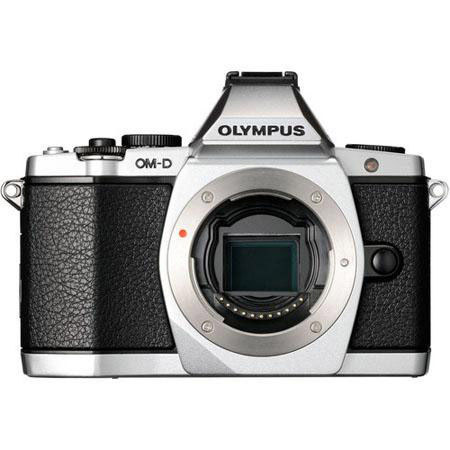
more

Picture does not represent the actual item


Picture does not represent the actual item
See Options
Need help? Ask our experts.
Review Summary
2014-12-01T19:00:00
I am a previous Olympus PEN user. I once owned an E-PL1 and later an E-PL2. I missed having a built-in viewfinder and didn't really care for the Olympus EVF that plugged into the hot shoe. So, I sold off the Micro 4/3 equipment and went with one of the Big Two brands. That camera ("The world's smallest DSLR") was actually pretty nice, but heavy lenses on a small body kind of defeated the purpose of a small scale camera. After a year or so, I looked at Olympus again. When I saw the OMD-EM5 at a great price, I just had to have it. I added the 12-50mm EZ lens, and the 40-150mm zoom lens. I have been pleasantly surprised at the quality of pictures coming from the EM5. I set up some informal comparison tests between the EM5 and my other camera. The Olympus, with either lens, was sharper and produced truer colors than my other camera. This was the case with both tripod-mounted and handheld shots. The 12-50mm lens is handy, and can do some macro work too. When used on the EM5, I don't have to worry much about taking pictures in less than ideal weather. But what I like the most, especially compared to the other camera, is the green frame you see in the viewfinder that indicates the area of focus. It is really frustrating on other systems to find that little red dot for a focus point. With the EM5, not only can I determine where the camera will focus, but it is especially easy to change the focus point, or even set a focus zone. This is a much better setup for me, and in combination with the EM5's quick focus, I am experiencing fewer out-of-focus shots. I know that many people are somewhat bewildered by the Olympus user interface, but it is easily learned. Many features are simply on/off options. The super control panel allows easy change of settings, as do the main/sub dials. When you combine this with the touch screen, you can really get comfortable with a particular way to set and use the camera. Overall, I am very happy to be back with Olympus. The OMD-EM5 is a great camera, with a solid feel, classic good looks, and excellent picture quality. The only reason I gave four stars is that, at this price point, Wi-Fi should be included. That is not a deal breaker though, with all of the other features and product quality. I would feel comfortable recommending this camera.
Daniel C.
2013-05-16T21:00:00
If you are a techie like me, this is the camera you need to get. This one offers so many little things you can configure and play around, it's so fun. oh and it also takes photos but that's not the point of this review. It takes a good photos but it's not anywhere APS-C or Full Frame quality. But as a techie, I do appreciate that the camera do produce nice looking pictures, just keep in mind that these are nice digitally looking photos, not exactly gives off that genuine film photos look and feel. but hey, it is what it is and as long as it looks good, that's all it matters, right? But like I said, this camera really shines when it comes to "using" the camera. It's just like a gadget toy that you can play around with setups and lens so much. If you are into playing around with cameras and taking photos is secondary, this is the camera for you! I love it!
Leica M.
2013-02-10T19:00:00
If your looking for a great camera that's compact, lightweight and take beautiful shots this is a good one. My other camera's are now collecting dust.
Dennis
2013-02-04T19:00:00
Olympus quality overall is a higher than the panasonic gh3. Image quality is arguably better than the gh3 despite having the same sensor.
SERGIO A.
2013-01-10T19:00:00
Ahh.. i guess i'll go into background of myself... Got into photography using a canon xsi, the t1i, wanted something more rugged and "professional" after a few years.. moved to the canon 60D.. liked the quality, love the size.. liked the look.. didnt like the weight. after a while it really got to u.. and then the big size you loved of it, (w/ grip) got to you, so I stopped using the grip.. and the camera got annoying to lug around... decided to make a full switch to m4/3.. got a epl-1 .. liked it alot. but after using a dslr.. its hard to admit it was a big downgrade. then i started to buy 4/3 (dslr) lenses for the epl-1 to improve the picture quality.. that worked well.. then missed a viewfinder.. bought a vf2.. liked it but hated how it was $$$ and it didnt lock on.. then the OMD comes out.. solved my problems. loved the size, the look , you can NOT deny looks awesome. the construction is very good, and feels like a small brick. the built in EVF is great too, and the screen on the back is nice and big. I use my olympus 4/3 14-54 mkii lens w/ the olympus mmf-3 to completely weather seal the camera and combo. this is the camera i've been waiting for and im glad i finally got it. picture quality is great. using my 14-54, or even the m4/3 14-42. i recently started experiementing w/ a 28mm 3.5 OM lens. and i love that combo and look. Image stablization on this camera is great, and u really notice it in shooting videos. its a great camera, alittle pricy, but you are really only going to get this if you know what you want and like the style.
wyluncustoms
4/3 Live MOS Sensor
Number of effective pixels: 16.1 million pixels
Total number of pixels: Approx. 16.9 million pixels
Aspect ratio: 1.33 (4:3)
Supersonic Wave Filter (dust reduction system for image sensor)
Primary color filter (RGB)
DCF, DPOF compatible / Exif, PRINT Image Matching III, MPO compatible
RAW (12-bit lossless compression), JPEG, RAW+JPEG, MPO(3D still)
[RAW] 4608 x 3456 pixels
[JPEG] 4608 x 3456 pixels - 640 x 480 pixels
RAW: 4608(H)x3456(V) (approx. 1/1.5 lossless compressed) Approx. 17MB
Set1(LF): 4608(H)x3456(V) (1/4 compressed) Approx. 7.5MB
Set2(LN): 4608(H)x3456(V) (1/8 compressed) Approx. 3.5MB
Set3(MN): 2560(H)x1920(V) (1/8 compressed) Approx. 1.1MB
Set4(SN): 1024(H)x768(V) (1/8 compressed) Approx. 0.3MB
Built-in (Image sensor shift type for movie & still, 5-axis image stabilization)
3 modes (IS1, IS2, IS3), OFF
Yes
Input focal length 8, 10, 12, 16, 18, 24, 28, 30, 35, 40, 48, 50, 55, 65, 70, 75, 80, 85, 90, 100, 105, 120, 135, 150, 180, 200, 210, 250, 300, 350, 400, 500, 600, 800, 1000
Maximum 5 EV steps
60 - 1/4000 sec. (Not available when Bulb is selected)
Eye-level electronic viewfinder, approx. 1.44M
Approx. 100% / Approx. 0.92x - 1.15x (-1m-1, 50mm lens, Infinity)
Approx. 18mm (-1m-1, Distance from rear lens surface) / -4 Apporx.. +2m-1
2-axis level gauge; horizontal /vertical
Selectable from 3 types
Removable, Optional eyecup EP-11 is available.
100% field of view, Exposure compensation preview, WB adjustment preview, Gradation auto preview, Face detection preview (up to 8 faces), Grid line, Histogram, Magnification display (x5/x7/x10/x14) OFF
Normal Mode, Grid Line Mode(4 types), Histogram Mode, Magnified View Mode, OFF
x5, x7, x10 (Default), x14
Max 8 frames of face detection can be displayed
3.0-inch tilting OLED monitor
Approx. 610k dots, Touch control in electrostatic capacitance Type
Touch shutter release, Touch enlargement, Touch Live Guide, AF area selection, AF area enlargement, Frame advance/backward, Enlargement playback, Touch Super Control Panel
Upward tilting angle: up to 80 degrees / Downward tilting angle: up to 50 degrees
Vivid / Natural
High-speed imager AF
Single AF (S-AF) / Continuous AF (C-AF)/ Manual Focus (MF) / S-AF + MF / AF tracking (C-AF + TR)
Yes
Selectable from over 800 AF points
Enlarged view check by magnify button
Magnification x5, x7, x10(Default), x14 selectable
Yes/Yes
Eye Detection AF mode: OFF / Nearer-eye priority / Right-eye priority / Left-eye priority
35-area multiple AF / All target, Group target area (9-area), Single target
Yes
Live view image is magnified when the focus ring is rotated. (at S-AF+MF or MF mode)
Yes
Digital ESP metering (324-area multi pattern metering), Center weighted average metering, Spot metering, Spot metering with highlight control, Spot metering with shadow control
EV 0 - 20 (at normal temperature, 17mm f2.8, ISO 100)
i Auto, P: Program AE (Program shift can be performed), A: Aperture priority AE,
S: Shutter priority AE, M: Manual, Bulb, Time, Scene select AE, Art Filter, Underwater wide / macro
Portrait, e-Portrait, Landscape, Landscape + Portrait, Sport, Night, Night + Portrait, Children, High Key, Low Key, DIS mode, Macro, Nature Macro, Candle, Sunset, Documents, Panorama, Fireworks, Beach & Snow, Fisheye Conv., Wide Conv., Macro Conv., 3D
AUTO: ISO 200 - 25600 (customizable, Default 200-1600) / Manual ISO 200 - 25600, 1/3 or 1 EV steps selectable
+/-3 EV in 1/3, 1/2, 1 EV steps selectable
Locked at 1st release of shutter button (can be set to Fn1/Rec button)
1/6 EV step, +/- 1EV range
Computerized focal-plane shutter
1/4000 - 60 sec. (1/3, 1/2, or 1EV steps selectable.)
Bulb: default setting 8min. (1/2/4/8/15/20/25/30 min. selectable.)
TL Auto, Auto, Manual, FP-TTL AUTO, FP-MANUAL
No
2 frames / Auto gain, Exposing on Recorded picture(RAW)
Flash Auto, Redeye, Fill-in, Flash Off, Red-eye Slow sync.(1st curtain), Slow sync.(1st curtain), Slow sync.(2nd curtain), Manual (1/1(FULL)-1/64)
1/250sec. or less (using the bundled flash)
Up to +/-3 EV in 0.3, 0.5, 1 EV steps selectable
FL-50/FL-50R, FL-36/FL-36R, FL-30, FL-20, FL-14, FL-300R, FL-600R
5500+/-400deg.K
Triggered and controlled by bundled flash (FL-LM2)
channels
4 groups (External flash 3 groups + a bundled flash)
Single-frame shooting, Sequential shooting, Self-timer
[Sequential shooting H mode]: 9.0 fps
[Sequential shooting L mode]: 3.5 fps/4.2fps in case of "I.S. OFF"
[RAW]: Max. 17 frames (in seq. shooting L), Max. 11 frames (in seq. shooting H)
[JPEG]: Up to full extent of data storage capacity (in seq. shooting L), Max. 17 frames ( in seq. shooting H)
Operation time: 12 sec., 2 sec. (cancel available)
2, 3 or 5 frames in 0.3/0.7/1.0EV steps selectable, 7 frames in 0.3/0.7EV steps selectable
3 frames in 2, 4, 6 steps selectable in each A-B/G-M axis
3 frames in 0.3/0.7/1.0EV step selectable
i-Enhance, Vivid, Natural, Muted, Portrait, Monotone, Custom, Art Filters selectable
MOV(MPEG-4AVC/H.264), AVI(Motion JPEG)
MOV(MPEG-4AVC/H.264 ), AVI(Motion JPEG)
[MOV]:
Full HD: 1920(H)x1080(V), 59.94i Recording
20Mbps(Fine) / 17Mbps(Normal): Aspect 16:9
HD: 1280(H)x720(V), 59.94i Recording,
13Mbps(Fine) / 10Mbps(Normal): Aspect 16:9
[AVI Motion JPEG]:
HD: 1280(H)x720(V), 30fps, Aspect 16:9
SD: 640(H)x480(V), 30fps, Aspect 4:3
Full HD: Approx. 29min(Fine) / Approx. 22min(Normal)
HD: Approx. 29min(Fine) / Approx. 29min(Normal)
Movie Effect: One shot echo / Multi echo
Art Filter Movie, Aperture priority Movie, Shutter Priority Movie, Manual Shooting Movie
Built in (Image sensor shift type image stabilization)
P: Program AE, A: Aperture priority AE, S: Shutter speed priority AE, M: Manual, Art Filter
Motion-JPEG Format: 1/12(HD), 1/8(SD)
MOV Format: Max 4GB
Motion-JPEG Format: Max 2GB
Stereo/Mono
Neutral, Yellow, Orange, Red, Green for Monotone
Neutral, Sepia, Blue, Purple, Green for Monotone
4:3(Default) / 3:2 / 16:9 / 1:1 / 3:4
RAW: Aspect ratio is recorded as Exif data, JPEG: JPEG image is produced based on the aspect ratio
Off, Low, Standard, High
Off, On, Auto
On: effective when shutter speed is slower than 1 sec.
Auto: effective when shutter speed is slower than 4 sec. (at ISO 200 or higher) or 8 sec. (at lower than ISO200)
2-axis
x2
Single-frame, Information display, Index display (4/9/25/100 frames), Calendar, Enlargement (2x - 14x), Movie (with sound, FF/REW/Pause), Picture rotation (auto), Slideshow (with BGM/BGM+Sound/Sound)
34 languages selectable: English, French, German, Spanish, Italian, Japanese, Korean, Traditional Chinese, Simplified Chinese, Russian, Czech, Dutch, Danish, Polish, Portuguese, Swedish, Norwegian, Finnish, Croat, Slovenian, Hungarian, Greek, Slovakian, Turkish, Latvian, Estonian, Lithuanian, Ukrainian, Serbian, Bulgarian, Rumanian, Indonesian, Malay, Thai
Dedicated multi-connector [USB: USB2.0 High Speed, Video: NTSC/PAL selectable, Optional Remote cable RM-UC1 can be used.]
Micro HDMI (Type-D)
Hot shoe
Dedicated multi-connector [Available for VF-2/VF-3, SEMA-1, MAL-1 and PP-1.]
USB 2.0 High Speed
HDMI (HD/Stereo Sound), VIDEO-OUT(SD/Mono Sound)
BLN-1 Li-ion battery (included)
Yes (1/3/5 min. off selectable)
32 Apporx.. +104 (operation) / -4 Apporx.. +140 (storage) Fahrenheit
30 - 90% (operation) / 10 - 90% (storage)
4.8 x 3.5 x 1.7 "/12.19 x 8.89 x 4.31 cm
Approx. 15 ounces/425.24g [ with BLN-1 battery and Memory card]
Approx. 13 ounces /368.54g [body only]

Want to catch the action? Here’s a quick guide to the gear—especially lenses--you need. Updated for Fall 2015. Whether you're shooting with a DSLR or a high-end Mirrorless Interchangeable-Lens Compact

Flush with the success of its digital revival of its legacy Pen line, Olympus today unveiled a digital version of ...

Olympus just announced the second generation of its super telephoto lens, the Olympus M. Zuiko ED 75-300mm f/4.8-6.7 II lens. It rep...
Adorama Photography TV presents the Olympus OMD-EM5. Rich Harrington describes the many features and functions of this sleek new camera that has a striking resemblance to classic Olympus SLRs.
The new, revolutionary mirrorless camera, the Olympus OM-D E-M5, has an exceptionally light and compact body. Its Electronic View Finder enables photographers to check exposure levels, white balance and preview Art Filter effects in real-time. When shooting, the photographer can instantly "create" a truly unique world and preserve it in exceptional quality. The "world" will be transformed from something you see to something you "take part" in.
The OM-D's new electronic viewfinder (EVF), with 120 fps refresh rate, features a high-resolution 1.44-million dot LCD, 100% field-of-view coverage and 1.15x maximum magnification that let you totally immerse yourself in your subject and actively control image creation. The EVF also enables you to enlarge the focus point for precision focusing in virtually any shooting situation and can show you the effect of Highlight & Shadow Control, White Balance, Exposure Compensation, Aspect Ratio and a host of other settings and advanced digital image processing functions right in the viewfinder. With improved precision and responsiveness that make it as easy to use as an optical viewfinder, the E-M5's advanced EVF gives you virtually unlimited creative control. Eye sensor technology automatically activates the EVF when you bring the camera to eye level.
The E-M5 is equipped with 5-axis image stabilization system and can compensate for vertical, horizontal and rotational camera shake that conventional 2-axis systems of the past have been unable to handle. Built into the camera body to ensure effective stabilization with all lenses, its unique 5-axis design makes it particularly effective when taking high-magnification telephoto shots, macro close-ups and long exposures. In addition, it can be activated by pressing the shutter button halfway, so you can also use it to stabilize the viewfinder image and obtain a crisp, clear view of your subject that makes it easy to frame and compose your shots.