

Let me introduce you to the One-Sentence Test. Can You Explain What You Do How You Help in 10 Words? That strikethrough is the most important edit you’ll ever make. Let me show you why.
Let’s be frank. Clients don’t care what you do. They care about what you can do for them. You are the center of your universe. The gear you own. Your portfolio. Your creative vision. The client is the center of their universe. Their problems, deadlines, and reputation. What you do is irrelevant to them, unless it hooks into what they need.
Let me share an example.
There’s a vitamin company in the UK. For years, they were Bigvits.co.uk, which says: “We sell a lot of vitamins.” (What You Do) They recently rebranded to Vytalise.co.uk, which says: “You’ll feel energized.” (How You Help) Same company. Same vitamins. One brand is about them. One brand is about you.
You have a Bigvits problem.
Your clients don’t want photos. They want what photos do.
- The bride wants to relive a day that vanished.
- The founder wants to look credible.
- The parent wants proof that their kids were this happy.
Describe what you do, you’re Bigvits. They nod and forget you.
Describe how you help, you’re Vytalise. They lean in and ask, “How?”
This article makes you Vytalise.
The One-Sentence Test
I help photographers and creators cut through the noise, because clarity is what gets you booked six months out. The ones who nail it share one thing: they can explain how they help in a single breath. Ten words or less. That’s the One-Sentence Test.
By the end of this article, you’ll have:
- A line that makes people curious, not confused
- Three exercises that help you create your line
- Three spreadsheets to do the work
- A formula that works for any creative
- A checklist to test your line
You’ve got one question to answer, over and over again. Let’s make sure you nail it every time.
So where do you start? Not with the sentence, with them.

The Three Steps to Your 10 Words
What if the sentence isn’t the hard part? Instead, the hard part is knowing who you’re talking to and what they actually need. Get that right, and the sentence practically writes itself.
Step 1: Decode what they actually want. Not the photo, the feeling behind it.
Step 2: Decode what you’re actually good at. Not what you think you’re good at, but what your clients thank you for.
Step 3: Connect the two in 10 words: their deepest want and your best skill. Bridge them into a single, clear sentence.
Let’s walk through each step together.
Step 1: Decode What They Actually Want
It’s hard to guess what’s in your client’s head. Start with the evidence, then dig beneath the surface.
We’ll do this in two phases.
Phase One: The 5 Ws – Gather the Facts
Think of a real client you remember clearly – their face, their business, their energy. Then answer these questions.
- Who are they? Demographics, role, business type, anything you know about them.
- What did they ask for? The specific deliverable. “Headshots.” “Wedding photos.” “Product video.”
- When did they need it? Was there a trigger? A deadline? A birthday?
- Where will your work live? Website? Instagram? Their mom’s fridge?
- Why did they say they needed it? Their stated reason. Write it exactly as they said it.
- How will they use it? Print, digital, presentation?
Now find the feeling behind the facts.
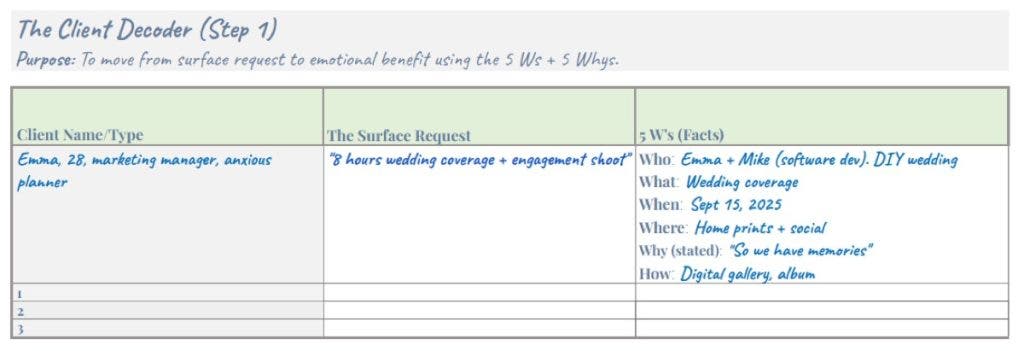
Phase Two: The 5 Whys – Find the Feeling
Take their “Why” the stated reason, and ask “Why?” five times. Answer them, using everything you know from Phase One. The best version happens in real conversations, so on your next call, ask “Why?” like a curious child. If you’re doing this alone, use what you know. Think of the real client, their face, their worries, and answer as them.
Let me show you how.
Meet Emma: 28, marketing manager, engaged 14 months, DIY planner with 4,000+ Pinterest pins.
On a call, she says, “I need someone to shoot our wedding. Probably 8 hours.”
That’s the surface request; now let’s dig deeper.
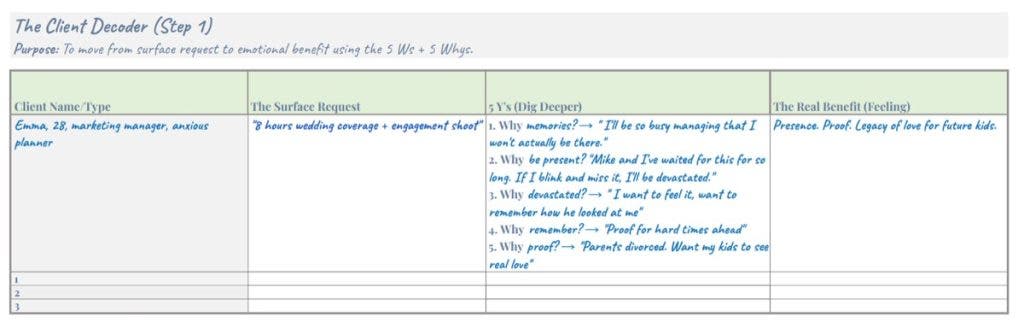
- Why do you want the photos?
“For the memories. Everyone says the day goes by so fast.”
- Why does that worry you?
“I’ll be managing, I’m scared I’ll miss it.”
- Why does missing it matter?
“If I blink and it’s over, I’ll be devastated.”
- Why would that devastation be so hard?
“I want to feel it, to remember how he looked at me.”
- Why does remembering that matter?
“My parents divorced. I want our future kids to see that real love exists.”
Stop there. You’ve gone from “8 hours of coverage” to “proof for her future kids that real love exists.” From a transaction to breaking a family pattern. That’s what you sell. Presence. Proof. A legacy of love. Stop when you hit a feeling. That’s the real benefit. Write it down for Step 3.
Decode What You’re Actually Good At
The Client Decoder Spreadsheet
This spreadsheet walks you through this exercise for three different clients. Download it, fill it, and see what patterns emerge. You might think you’re good at lighting or composition. But your clients might thank you for something different. Showing up early. Making them laugh. Perhaps for being calm when things go wrong.
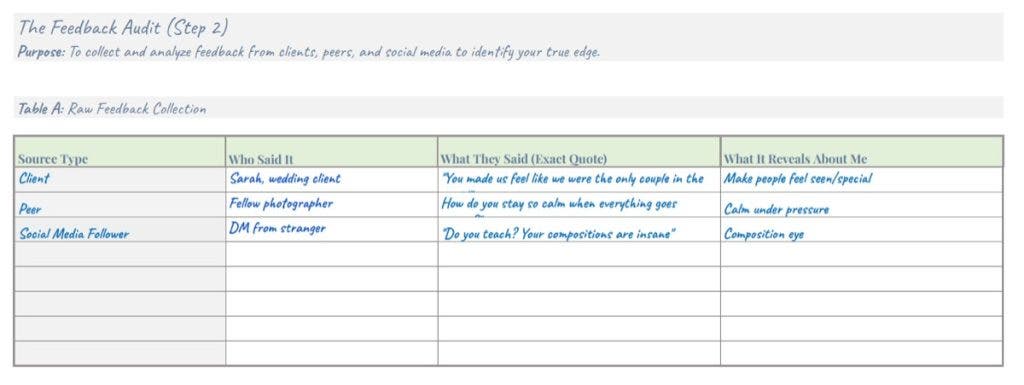
Your edge isn’t what’s on your website. It’s what people mention in passing, in reviews, in DMs, in casual comments after the shoot. This gold mine of data has been gathering dust for years; now it’s time to mine it.
The Feedback Audit Spreadsheet
Spend 15-30 minutes digging through:
- Client emails and texts
- Reviews and testimonials
- Social comments and DMs
- What peers say at shoots or events
- What people ask you to teach them
Write down exact quotes, don’t summarize, and don’t edit. Then use the spreadsheet and see what patterns emerge.
Find the Overlap
Now look across all three columns. What appears in multiple places?
Maybe clients and peers mention your calm presence, and followers sense it in your images.
That skill is your true edge. Write it down for Step 3.
Step 3: Connect the Two in 10 Words
Now you have:
Their real want: The feeling from Step 1
Your real skill: The edge from Step 2
You just need a bridge to connect what your clients need with what you’re good at.
The “By/Without” Formula
There are a million ways to say it wrong; these two ways say it right. The first is the Positive Frame (“By” or “With”). Your skill is how they get what they want, and this frame makes that clear. I help [Audience] get [Benefit] by [Your Skill].
“I help founders look credible to investors by making them comfortable on camera.”
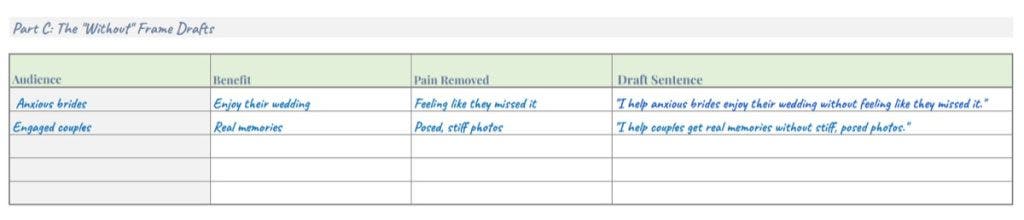
The second is the Painkiller Frame (“Without”). Use this when your skill removes something they dread. It names the enemy and shows you understand their pain. I help [Audience] get [Benefit] without [The Pain They Fear].
“I help founders look credible without awkward studio sessions.”
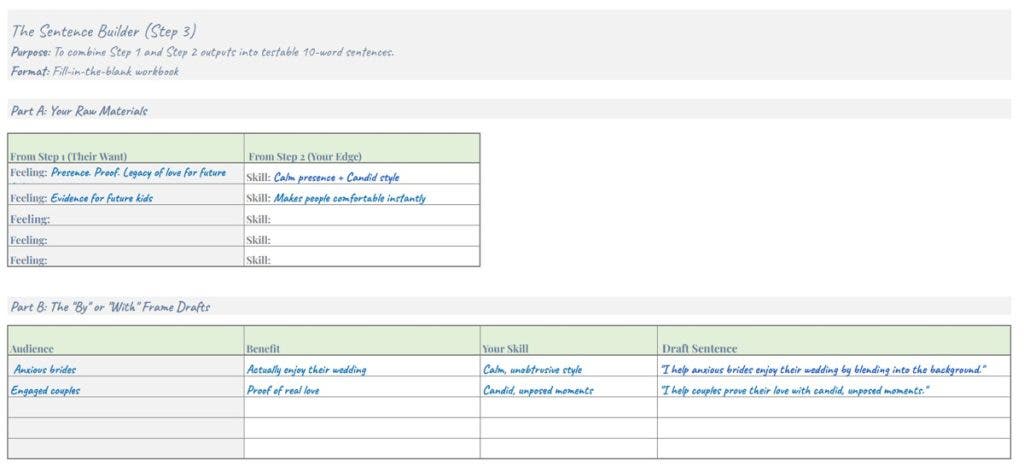
The Sentence Builder Spreadsheet
Now use the spreadsheet to walk you through drafting and refining your sentence.
Your Draft is Ready, But Does it Sound Like You?
Read your final sentence out loud. Does it sound like you? If it feels like a corporate robot wrote it, rewrite it. If you wouldn’t say it to a friend at a barbecue, it’s not ready.
The Testing Lab: Does Your Sentence Work?
You have a draft. Now test it on real humans with these:
The Stranger Test
Say it to someone who has no idea what you do. Uber driver. Barista. The person next to you on a plane.
Don’t listen to their words, watch their face.
- Confusion: Too vague. Go back to Step 1. They don’t get who you help or what you do.
- Nod + “Cool”: Clear, but forgettable. Try the “without” frame. Name a pain.
- Nod + “Wait, how do you do that?”: Bingo! You’ve hooked them.
The 6-Year-Old Test
Say it to an actual child (or imagine one). Did they understand?
The Follow-Up Question Test
The best lines don’t tell the whole story. They make people want to know the rest. If your sentence ends the conversation, it’s too complete. If it starts a conversation, it’s perfect.
The Practice Loop
Say it 20 times in the shower, to your dog, to your reflection. Make it feel natural, not rehearsed. It should feel like an old T-shirt, not a stuffy tuxedo.
The One-Sentence Test Checklist
One final filter before you use it for real.
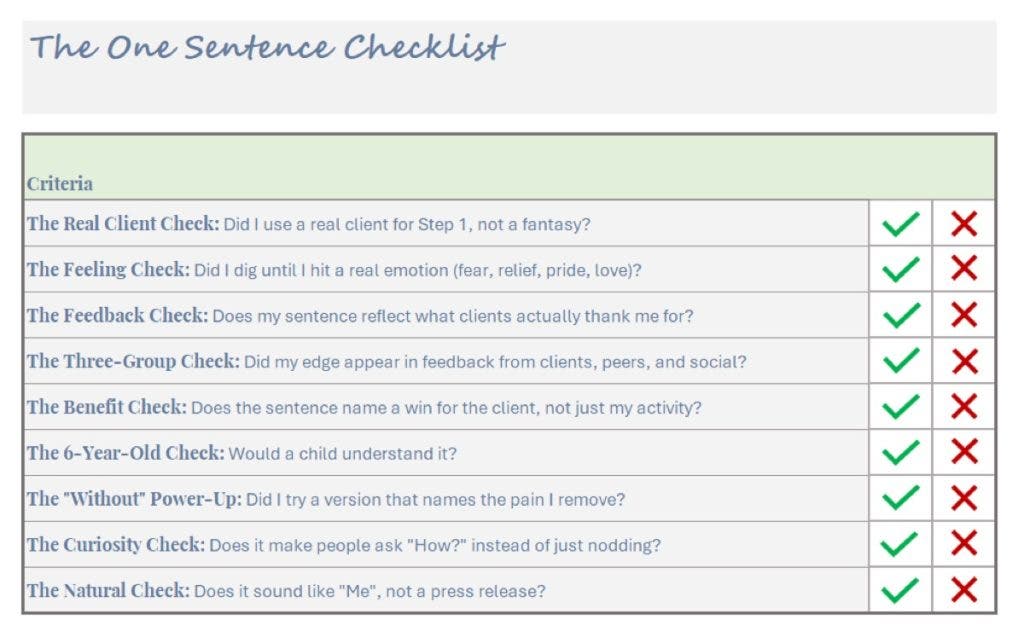
Download The One-sentence Checklist
Bonus Spreadsheet: Before / After Tracker
Your sentence isn’t a one-and-done thing. It grows as you do. Every few months, revisit the client Decoder, Feedback Audit, and Sentence Builder. Then come here to see how far you’ve come.
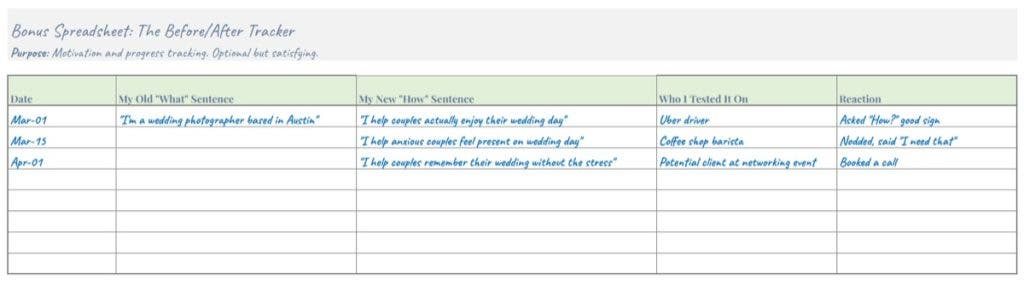
Download the Bonus Spreadsheet
Your Turn
You now have a framework that works, exercises that dig deep, spreadsheets that leave no room for self-deception, and a checklist that catches what’s not ready. The only thing missing is the sentence that only you can write. You’ve got the gear. You’ve got the skill. Now give them the words to remember you by.
Further reading: How to Get the Best Out of Your Clients