Since the dawn of mankind, people have connected through visual stories. Whether a San rock painting, a Baroque masterpiece, or an immersive social media reel captured on a 360 camera, all are forms of storytelling. From pranks, songs, and educational content to entertainment and political videos, the experience relies on moving images, immersive sound effects, music, and narratives that take us on a journey of sharing and of emotions.
This article covers 360 cameras and how they are revolutionizing videography. The GoPro Max 2, in particular, has simplified my storytelling process as a solo creator who makes short films, records his travels, and creates behind-the-scenes content for educational purposes. These newest 360 cameras have officially evolved from niche, experimental gadgets into serious, everyday filmmaking tools.
The Burden of the Solo Creator and Capturing Behind-The-Scenes

Behind-the-scenes content adds value for viewers but can be challenging to film using traditional methods.
Solo content creation demands physical and mental presence at all times, especially when traveling with heavy gear. I primarily use a Sony A7s III with a 24-70mm f2.8 lens and also carry a 61-megapixel Sony A7r IV for photography. The need to frequently switch between multiple lenses – 50mm and 85mm for portraits, 17-28mm for landscapes, and a 70-200mm for distant subjects – adds to the physical load.
To capture behind-the-scenes, I often set up a tripod with one camera positioned to include myself in the frame. I frequently move the camera to capture different angles, asking someone to record me or use a chest-mounted action camera for a point-of-view shot. While this enhances the viewer’s experience, it also increases my on-location admin.
None of these cameras can simultaneously record me and what I am photographing. This also misses key elements of storytelling, such as the creator’s facial expressions, dialogue, and genuine reactions.

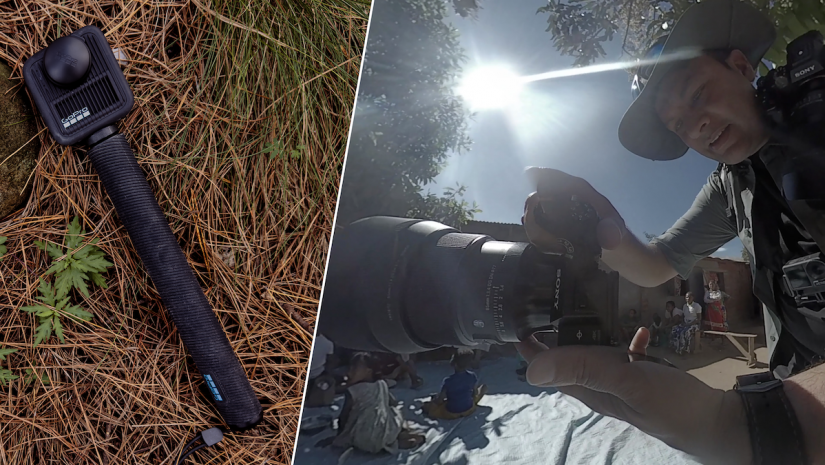
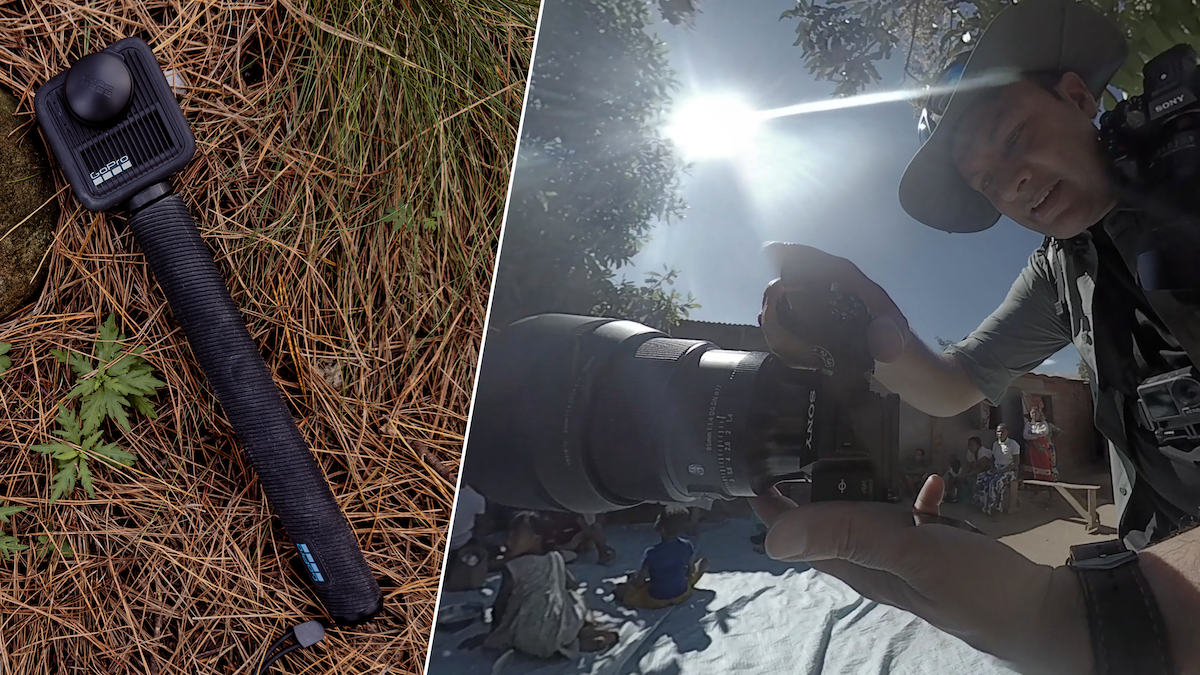
Caption: You can mount the 360 on the hotshoe, or leave it standing on the side to record the action
Juggling this equipment forces a creator to constantly prioritize: do I shoot a photo right now, or do I roll video? It can distract you from the moment and the stream of consciousness of your narrative.
The “Shoot Now, Edit Later” Philosophy
It is at this intersection of frustration and missed opportunities that the 360 cameras made their debut. By mounting a 360 camera directly to the hotshoe of your main camera, a massive weight is lifted off your shoulders. Suddenly, your hands are completely free to operate your primary gear. This allows you to focus entirely on taking your photos while the 360 camera silently captures a completely immersive, dynamic behind-the-scenes narrative.

Focusing on the story using the shoot now, edit later philosophy
The magic here lies in a liberating new philosophy: “shoot now, edit later”. When the field of view of the camera captures everything in a sphere around you, you no longer have to worry about framing in the moment. The constant battle of photography vs videography vanishes. You simply focus on the action, live in the environment, and reframe the footage in post-production to point the camera exactly where you want it. This philosophy eases a profound amount of burden for the creator.

On the move with a 360 camera, immersive angles on the go
Using an invisible selfie stick also unlocks incredible flexibility for solo operators. You can simultaneously shoot multiple forms of footage and select your options later in the editing room using GoPro’s Quik editing software:
- Aerial Perspectives: You can raise the stick high above your head to mimic a drone for establishing aerial shots.
- Third-Person Views: You can hold it out to capture unique, third-person perspectives without the stick ever showing up in the final video frame.
- Traditional POV and Action Camera angle: You can also switch your 360 to POV mode and use it as a regular action camera for burst shots, hyperlapses, and timelapses.

Maximizing time efficiency with a 360 camera while prioritizing what truly matters.
Busting the Myth: 360s are Just for Thrill Seekers
The biggest misconception about 360 cameras is that they are only for adrenaline junkies and extreme sports. In reality, they empower everyday creators to tell their stories. You do not have to be a tech geek to use one. They are perfect for tourists wanting to capture vacations, casual travelers, or even filmmakers seeking unique shots. Whether you are a chef in a busy kitchen, a tourist, a vlogger, or just strolling through a forest, a 360 camera lets anyone document their experience effortlessly. Just set it up, let it roll, and uncover the story later.
Enter the GoPro Max 2
There are several brands on the market. However, my long experience with GoPro action cameras has made the GoPro Max 2 an easy choice. The GoPro Max 2 stands out for accessible content creation. Before we look at the specs, please note that our focus should be on convenience and features. After all, we are already getting great quality from a top brand. I have a GoPro Max 2 accessories kit. With it, I have a few mounts, a 64 GB SanDisk Extreme microSD card, and a selfie stick. I use a 256 GB SanDisk Extreme microSD for extra storage during my travels; its efficient read and write speeds and the reliability I have experienced for years.
| Feature | What it Means for Creators |
| True 8K Resolution | Captures incredibly detailed full spherical video at up to 30 frames per second. This massive 8K sphere gives creators the latitude to dynamically crop in and pull flat 4K or 1080p shots. |
| Various Resolutions & Frame Rates | Offers flexibility beyond just 8K. You can shoot in 5.6K at 60fps for buttery smooth slow-motion reframing, or drop down to 4K at 90fps for even slower motion. |
| 10-Bit Color Depth | Records a significantly higher amount of color information, allowing for far more latitude and precision when color correcting in post-production. |
| Log Footage Option | Provides a flat “Log” color profile specifically designed for filmmakers and creators interested in manually color grading their footage from scratch. |
| TimeWarp & Time-Lapse | “TimeWarp” allows you to record a hyper-stabilized hyperlapse while moving, speeding up time for a dynamic, sweeping effect. It also features standard scenic time-lapse video for tripod mounting. |
| Advanced Night Modes | Features specialized 360 night modes, including “Star Trails” to capture the night sky’s movement, “Vehicle Lights” for long-exposure traffic scenes, and “Light Painting” to write with light in a 360 space. |
| Replaceable Lenses & Durability | The device is fully waterproof without needing an extra case (though a dive case is required for underwater clarity due to the curved lenses). Crucially, the external lenses are completely removable and replaceable; if you scratch one in the field, you can simply unscrew it and twist on a fresh one. |
| Single Lens Modes & Horizon Lock | Operates as a 360 camera and traditional action camera. “Single Lens Mode” offers flat video up to 4K at 60fps with ultra-wide perspectives (Max HyperView) and full 360-degree Horizon Lock. |

Focus on technical details only for specific projects.
Final Remarks
The shoot now, edit later philosophy has made life easier for me. All as an educator, solo filmmaker, and even a traveler. From the time-consuming, meticulously crafted yet simple vlogging style of Casey Neistat, where the camera is placed in your path several times to capture a single move, to the cinematic B-roll style of Peter McKinnon, where careful camera settings, frame rates, color grading, sound effects, and music are important, creators have moved toward simplicity, where delivering the message is prime. Do not let the term 360 intimidate you. These cameras are easy to use. And above all, a passport to immersing yourself in the experience rather than worrying about technology. Basically, with 360, all options are on the table while you are in your own action mode. Plus, you can decide how to swing your content later in the editing room.