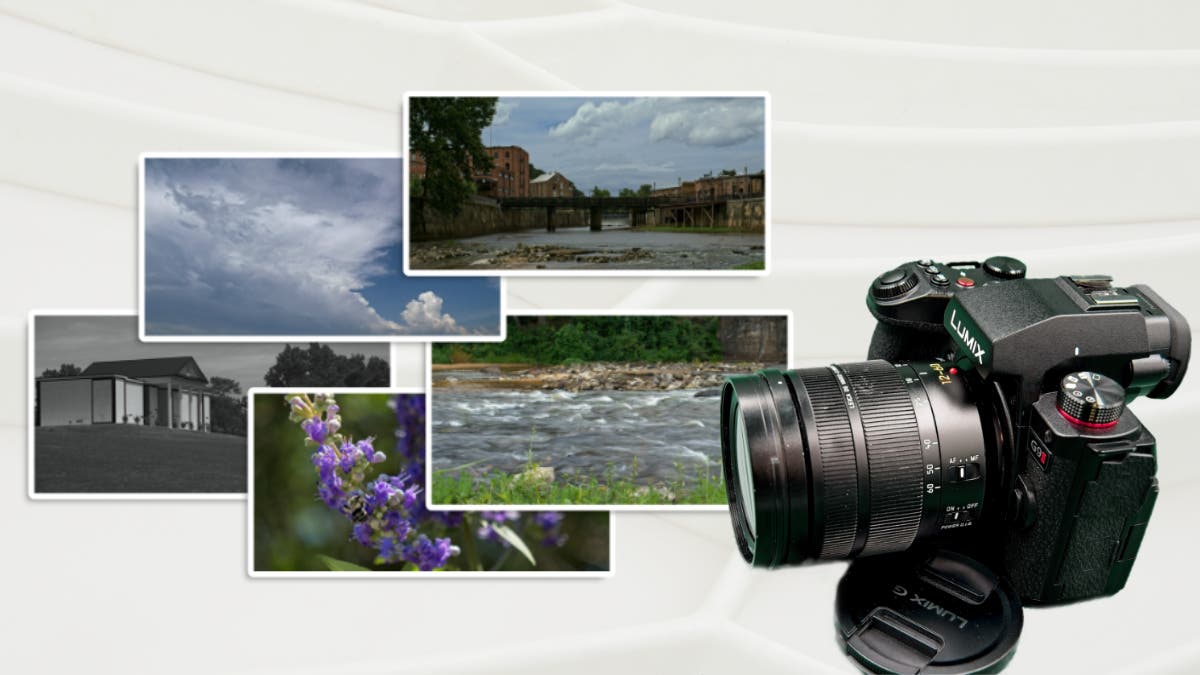
Lumix cameras, especially the Micro Four Thirds format, are often woefully overlooked in far too many discussions. The big three, Canon, Nikon, and Sony, get all the attention. Meanwhile, LUMIX continues to deepen its camera lineup and innovate ahead of the curve. In fact, LUMIX (Panasonic) and Olympus were the team behind the first MFT mirrorless interchangeable lens camera back in 2008.
An Emphasis on Micro Four Thirds
While LUMIX also has nicely filled-out compact point-and-shoot and full-frame lines, the LUMIX G Series Micro Four Thirds lineup and innovations are worth exploring.
What started as a Four Thirds collaboration from Olympus and Kodak morphed a few years later into a collaboration between Panasonic and Olympus, resulting in 2008’s LUMIX DMC-G1, the first mirrorless interchangeable MFT camera.
The new mount was an open standard, clearing the way for smaller companies like Blackmagic Design and DJI to quickly adopt MFT for cinematic and drone use, something Panasonic/ LUMIX also embraced.
Micro Four Thirds: What It Means in Practice

If you haven’t shot with MFT before, there are some things you need to know, both good and not so good. For example, the smaller sensor helps reduce power needs, leaving plenty of capacity and space for LUMIX and other MFT brands to pack camera bodies with extra features like strong IBIS or in-camera LUTs.
Also, in general, MFT gives you the equivalent of double the reach and depth of field compared to the same lens specs on a full-frame sensor. That’s absolutely just a rule of thumb, not the detailed technicals, but it works to keep in mind in the field.
The smaller sensor’s 2x crop factor means you effectively get a crop when shooting, rather than later in editing. Your 300mm lens will look like you shot on a 600mm lens for a full-frame camera. Depth of field will also be larger, with an f/8 behaving more like f/16, although you aren’t changing light that drastically.
Note: The DOF is based on stepping back to frame how you would on a full-frame camera. IF you don’t step back and accept the crop, the DOF remains the same.
Another quirk of the MFT sensor is more noise, or more noticeable noise at lower ISOs than larger sensors, at least. You’re packing a lot of data into a small space, and that contributes to noise showing up earlier, especially in low-light situations. In the same vein, that smaller sensor means you can collect only so much data in one shot, and MFT sensors typically average 20 to 25MP.
Shooting With a Lumix Camera

I recently spent the better part of a month shooting with LUMIX, and there’s a lot of love. But a few things broke my heart as well.
Three things I fell in love with:
- Fabulously tactile controls, especially the dedicated top buttons for ISO, white balance, and exposure compensation on the G9II.
- Sane menu setups. Many systems have complex menus that leave even long-time brand acolytes scratching their heads. Lumix’s easy-to-navigate menus were a breath of fresh air. There was no need to adjust a dozen settings before starting out. I was able to pick it up out of the box and quickly make minor adjustments on the fly without deep research into menus.
- I was pleasantly surprised with RAW images straight out of the camera. The color handling and lighting often needed very little editing compared to other brands’ RAW images.
Three things that broke my heart:
- No mechanical sensor protection when the camera is off, so you are left constantly fighting sensor dust when changing lenses.
- Buffer speeds were sometimes disappointing when shooting the G9II, and I frequently missed action and wildlife sequence shots. While the buffer size itself is good, it clears rather slowly to the card even with a fast HDSC card.
- Charging via USB is common, but even with better battery life, many of us like to keep multiple batteries charged. Relying on in-body charging alone makes that cumbersome. Treating external battery chargers as an add-on with several models, rather than included with camera bodies, is a personal pet peeve.
Lumix Lenses

Impressive sums up my thoughts on Lumix and Leica DG lenses. Even the kit lenses, like the Leica DG Vario-Elmarit 12-60mm f/2.8-4 ASPH, were solid performers with tack-sharp focus and quick autofocus. I found myself leaning heavily on the kit lens in many shooting situations.
Like LUMIX cameras, the lenses have a solid retro feel to them, more substantial and metal to the hand than most brands without adding a lot of weight.
Honestly, my only issues with the LUMIX and Leica series lenses I tested were that 1. the camera bodies are so lightweight that even small lenses tip them forward on flat surfaces and 2. even the tiniest bump popped off the lens caps.
Portability
It’s hard to argue with less carry fatigue. Lightweight bodies plus being able to use smaller lenses thanks to that 2x crop factor meant less energy spent carrying the gear and more available energy to hold the camera at the ready while waiting on subjects. Not super noticeable on short treks, but when you’re hiking a few miles to get to a location, it makes a big difference.
Favorite Features

Brands always emphasize all the bells and whistles of their gear; that’s the norm. But what really struck me with LUMIX was that the bells and whistles were useful, not just more marketing hype.
Granted, exact features vary by body, but my favorites from working with the LUMIX gear were:
- Built-in LUTs: I’m always going to like the freedom of RAW editing, but the convenience of well-done LUTs, including a Leica Monochrome, for ready out-of-camera JPEGs is incredibly freeing for most shooting situations on the G9II and GH7.
- Outstanding IBIS: The smaller MFT sensor has made truly outstanding in-body image stabilization possible. I was able to capture usable shots as slow as one second handheld.
- High dynamic range options: Features vary between bodies in LUMIX’s MFT lineup, but options like dynamic range boost (DR boost), in-camera stacked-shot HDR, and HLG (Hybrid Log-Gamma) profile all add more flexibility to your shoots.
- Subject detection: Like all brands’ subject detection modes, LUMIX’s are occasionally hit-or-miss, but I was glad to see they perform fairly strongly most of the time. It was also nice to see that some models, like the GH7, differentiate between cars or motorcycles and trains and planes as well.
- Extra resolution: Handheld or tripod mode options to stack burst shots for up to 100MP (depending on model) give you that detail boost you need when you know you have to deeply crop after the shot.
Panasonic’s LUMIX Micro Four Thirds Camera Lineup

The LUMIX G Series features MFT sensors and offers great flexibility from top-end pro shooting to pocket travel cameras to drone use. One thing that really struck me about the LUMIX G Series lineup is the versatility. It isn’t just for one type of photographer or filmmaker, and even the budget-conscious entries offer a lot of performance.
LUMIX BGH1 Box Camera
Great for: Multi-camera livestreamers, solo videographers, event videographers, drone/gimbal/vehicle video
Created for video, the BGH1 is built with cinematography in mind. Designed for drone, gimbal, and vehicle mounting, the Lumix box camera features powerful remote controls and live streaming options.
LUMIX GX85
Great for: Budget-conscious hybrid shooters, minimalist photographers/videographers, street photographers, travel photographers
Its compact profile, paired with the power of larger bodies, makes the GX85 a great option for travel and street photography. Five-axis dual IBIS using optical and magnetic stabilization meets sharpness, thanks in part to the lack of an optical low-pass filter.
LUMIX G85
Great for: Adventure travel photographers, solo content creators, vloggers, street photographers, beginning hybrid shooters
A bit chunkier than the GX85 but still compact at about half the bulk of a standard DSLR body. The G85 gives you a more substantial body to hold while staying compact enough to carry easily in almost any situation, with a more ergonomic grip than smaller cameras.
LUMIX G97
Great for: Content creators on the move, storm chasers, budget-conscious travel videographers, hobbyist photographers, budget-conscious shooters, photographers preferring in-camera editing
The G97 ticks a lot of boxes. From great IBIS and 4K video to in-camera live composite and color styles, it frees photographers from long editing sessions on the computer with usable output straight out of camera.
LUMIX G100
Great for: Vloggers, social media content creators, casual hybrid shooters, travel content creators
Pocket-sized compact freedom for content creators with a focus on video. It shoots QFHD 4K video at 24p or 30p and HD at 60p plus strong video image stabilization for moving while shooting without a gimbal.
LUMIX G100D
Great for: Mobile content creators, vloggers, travel videographers, creators with a USB-C workflow, adventure travel videographers
This updated version of the G100 swaps the micro-USB port for a Type-C USB port. Plus, it features advanced video image stabilization and updated viewfinder technology with a smooth OLED for a better shooting experience.
LUMIX G7
Great for: Tight budget videographers, photography students, street photography, beginning YouTube creators, shooters needing a lightweight body, photographers needing tactile controls
Meeting tight budget constraints while still delivering strong features and quality output, the G7 helps level the playing field for beginning creators. The ability to pull a photo from a frame of video in-camera beautifully balances today’s creators’ needs for video and photo without needing a second shooter or interrupting the flow of a shoot.
LUMIX GH7
Great for: Professional filmmakers, indie filmmakers, wildlife videographers, YouTube creators, sports videographers, documentary makers, photographers exploring high-end video
Still a hybrid camera but geared for motion, the GH7 gives filmmakers and creators access to next-generation sound with 32-bit float recording with an adapter and also records internally in Apple ProRes RAW. Combined with phase detection AF, which adds subject-type recognition, the GH7 offers action and wildlife shooters (video and still photography) more reliable focus in rapidly changing situations.
LUMIX GH5II
Great for: Direct-to-platform live streamers, adventure travel photographers and videographers, indie documentary filmmakers, storm chasers
An update to the GH5, the GH5II adds even more freedom from long-editing sessions for filmmakers with wireless livestreaming, simultaneous HDMI output and preloaded V-Log L. It meets videographers in the moment they’re shooting for fast production without leaving behind the features still photographers count on.
LUMIX G9II
Great for: Landscape photographers, architectural photographers, event and portrait photographers, gear minimalist photographers, hybrid shooters with a focus on stills, street photographers, hobbyist wildlife photographers
Geared for still shooters but still video capable, the G9II is a top-end workhorse for almost any photography type. Powerful IBIS, high-resolution photo stacking, real-time LUTs, and great RAW color handling give every photographer something to love.
Should You Make the Jump to LUMIX?

Whether you completely ditch your old system or add LUMIX as a new tool in your existing lineup, there are a lot of options to fit your style. Plus, if you’ve ever grumbled under your breath about overly complicated menus or feel your current camera ecosystem has gotten pointlessly overcomplicated, LUMIX could be a strong contender to add to your workflow.
If you aren’t ready to ditch everything for a jump, indulging in a personal fixed-lens everyday camera might be the breath of fresh air you need. Check out what Fernando Martinez has to say about the Lumix L10 difference.