You’ve heard it before: “Get 100k followers, buy better gear, learn new skills, then you’ll get paid brand deals.” You grind, you upgrade, you wait. Nothing happens.
The problem is you’re approaching brands like a hopeful amateur, not a professional problem‑solver. You’re asking, “Can I work with you?” instead of “Here’s how I solve your problem.”
This article gives you a different system, one that works with the audience you have, the gear you own, and the skills you’ve already built. A repeatable way to land paid brand deals.
Here’s what we’ll cover:
- What brand deals look like
- Brand Deal Readiness Scale
- Step 1: Find brand pain points
- Step 2: Fix your content
- Step 3: Pitch
- What happens next
Let’s start with the specifics of a brand deal with numbers and deal types.
What Brand Deals Look Like and How to Land Paid Brand Deals as a Micro-Creator
If you have between 1k and 20k followers, you’re in the sweet spot for micro‑creator partnerships. Here are the most common deal types for photographers.
| Deal Type | What You Deliver | Typical Fee (USD) | Notes |
| Sponsored social post | 1-3 images or a Reel for brand’s feed | $150 – $1,000 | Most common; Reels pay more. |
| Product review / tutorial | Honest review on YouTube, blog, or social | $100 – $1,500, or free product, or both | Fee, product, or both. |
| Content licensing | 5-10 custom images with limited usage rights | $200 – $1,000 per batch | Often an add on. |
| Affiliate / Ambassador | Discount code/link; regular posts featuring gear | $100 – $500/post + 10-20% commission | Longer term, monthly minimum. |
| UGC (User Generated Content) | 5-10 images/clips for brand’s use (you don’t post) | $200 – $800 per batch | Brands buy authentic photos |
Rates vary by engagement, niche, and usage rights. Broader usage = higher fee.
Brand Deal Readiness Scale
Brands don’t just buy a post. They buy a credible voice that speaks to the people they want to reach. Here’s what they actually value in a micro‑creator:
- Authentic engagement: comments, saves, shares, and DMs from real followers who trust your opinion.
- Niche relevance: your audience matches their target customer.
- Professional presentation: a clear bio, focused portfolio, and obvious trust signals.
- Proactive problem‑solving: you think about how you can help them, not just “can I get free gear?”
- Reliability: You deliver on time, communicate clearly, and make the collaboration easy.
That’s why a creator with 5k engaged followers in a specific niche can out‑earn someone with 50k random followers.
Now let’s see how that translates into real Instagram profiles. Below are three real examples – one vague, one clearer, one brand‑ready.
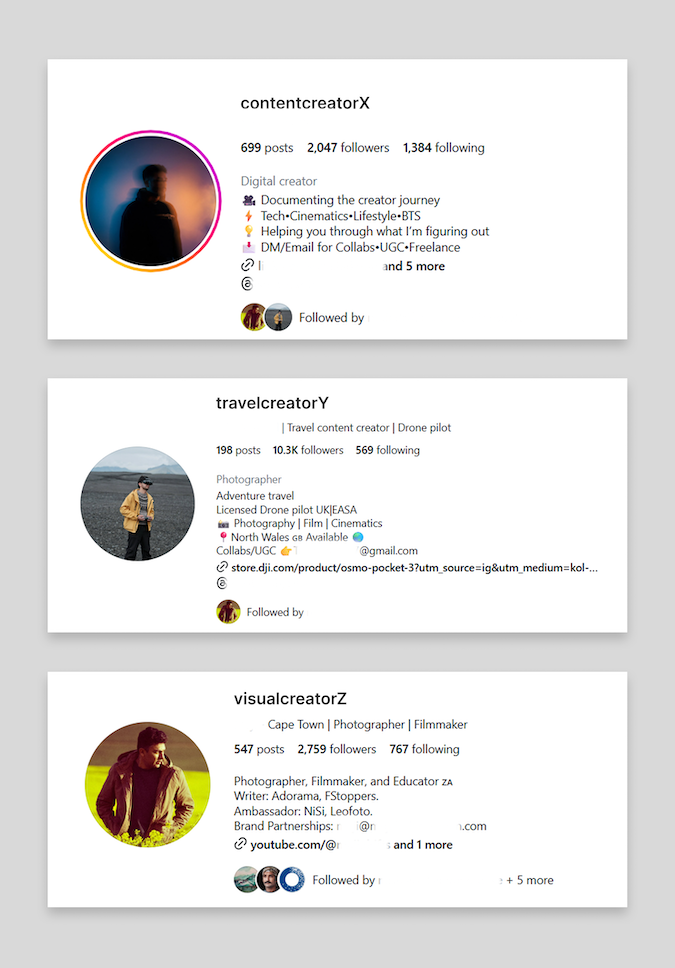
| Criteria | @contentcreatorX (Vague) | @travelcreatorY (Clearer) | @visualcreatorZ (Brand-Ready) |
| Niche | “Digital creator” – too broad | Adventure travel + drone pilot | Photographer, Filmmaker, Educator |
| Headline / Value Statement | None | Describes what, not how you help | “Writer: Adorama, FStoppers. Ambassador: NiSi, Leofoto.” |
| Call to Action (CTA) | None | “Collabs/UGC 📍 #########@gmail.com” | “Brand Partnerships: creatorZ@creatorZ.com” |
| Trust Signals | None | Licensed drone pilot | Writer for Adorama & FStoppers + Ambassador for NiSi, Leofoto |
| Location | Not mentioned | North Wales, GB | Cape Town (in display name + 🇿🇦) |
| Readiness | Low | Moderate | High |
What we can learn from them:
I’ve worked with and observed these creators. Here’s what actually happens:
@travelcreatorY gets approached because of his location (outdoor hub) + credential (licensed drone pilot) + direct email.
@contentcreatorX gets free products for reviews and tutorials, but no paid work. His bio lacks a clear offer, location, or trust signals.
@visualcreatorZ is reachable and brand-ready since he updated his passive CTA “Message” to direct email + ambassador roles + location.
The lesson: Brand‑ready = niche + location + clear CTA + trust signals. @travelcreatorY has three, @visualcreatorZ has all four, @contentcreatorX has none.
Now that you know what a brand‑ready profile looks like, let’s get you there, starting with finding what brands actually need.
Step 1: Find Brand Pain Points
Instead of waiting for brands to post open calls, find their needs proactively.
- Visual Gap Audit: Pick a brand. Study their feed, website, etc., to find a missing angle (e.g., real‑life use case). Shoot a sample that fills the gap. Send it with a short note: “Your feed is all studio. Here’s an outdoor version.”
- Competitor Gap Analysis: Look at a brand’s main competitor. Scroll through reviews and comments, and look for what customers complain about. A weak spot for one is an opening for another. Pitch: “Your competitor’s audience is asking for real‑life shots. I specialize in that. Here’s a sample.”
- Attract, Don’t Chase: Instead of pitching, publish high‑quality, niche content consistently. Make your work visible. A photographer I work with never pitched Adorama. He posted great videos and tutorials; Adorama reached out and invited him to contribute.
Track your finds with this spreadsheet.
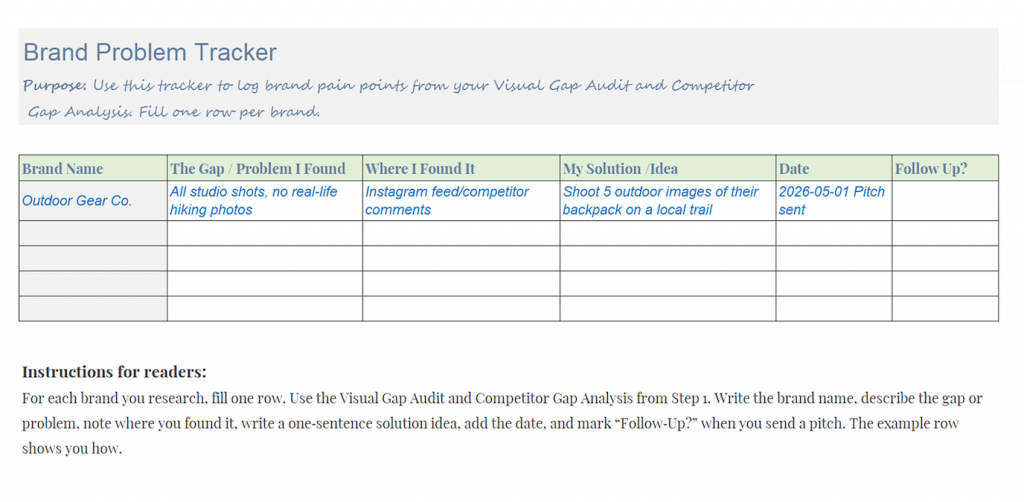
Download: Brand Problem Tracker
Step 2: Fix Your Content
Now you know what brands need, time to make sure your portfolio and bio prove you can deliver it.
- Your bio needs a 10‑word “how you help” line. Replace vague bios like “Photographer | DM for collabs” with a clear promise: “I help outdoor brands capture authentic adventure content.” (Here’s how to create your line→ [Link to The One-Sentence Test])
- Your portfolio needs focus. Only keep the kind of work you want brands to hire you for. Remove work you don’t want brands to pay for. Show gear shots for gear deals; real‑life location work for travel campaigns. (Here’s how to identify your ideal customer and their problem→ [Link to What Gear Actually Pays for Itself])
- Your trust signals need to be obvious. List credentials, past brand work, or media mentions. Even one line, “Writer for Adorama & FStoppers” or “Licensed drone pilot”, raises credibility. (Here’s how to fix the trust signals → [Link to What your Website is Actually Saying])
These three fixes help you land paid brand deals, not just free products.
Download: Content Fix Checklist
Step 3: Pitch (The Email That Helps You Land Paid Brand Deals)
You’ve done the research. You’ve fixed your content. Now send the email that turns a pain point into a paid opportunity.
The old way: “Hi, I love your brand, here’s my media kit.”
The new way: Solution‑first email (choose the approach that fits):
Subject: Quick idea / A visual gap I noticed / [Competitor] vs. you
Opening (pick one):
“I’ve been following [competitor] and noticed their audience asks for [X]. You can fill that gap.”
“I did a visual audit of your feed, all studio shots. Your customers want real‑life usage.”
Bridge: As a [niche] photographer, I specialize in [your strength].
Solution: What if I created [specific deliverable] that shows [how it solves the gap]?
Soft ask: Open to a 10‑min call to walk you through a sample?
Negotiation rules (don’t skip these):
- Never name a price first. Ask: “What’s your budget range for similar content?”
- Anchor to value, not followers. “My audience is small but highly engaged and exactly your target. I create content that converts.”
- Use the “What if” close as a follow‑up. After 5‑7 days, if there’s no reply or “maybe later”, follow up with: “What if we started with a single post to test whether my angle works? Low risk, quick to execute.”
Download: Solution‑First Pitch Template
What happens next (if they say yes)
You’ve pitched. They’ve agreed. Before shooting, send a Test Project Proposal, a one‑pager outlining deliverables, timeline, and fee.
Download: Test Project Proposal Template
Then turn one job into repeat work.
1. Deliver on time (or early).
2. Send a short follow‑up note: “Here are the assets. My next step is [idea].”
3. Ask for a testimonial using two questions: “What was your main worry before working with me? What specific result did you get?” Get result-driven quotes you can use in your next pitch.
Download: Testimonial Two‑Question Template
The 80/20 Breakdown
Most of what creators do to land brand deals is busywork. Here’s what actually moves the needle.
The 20% that drives 80% of results:
- Research 10 brands (Visual Gap Audit, Competitor Analysis)
- Fix your bio, portfolio, and trust signals
- Send 5 solution‑first pitches (not 50)
- Follow up once with the “What if” close
The 80% you can stop doing:
- Obsessing over follower count
- Applying to hundreds of open briefs
- Cold emailing random brands
- Waiting to be noticed
Do the 20% consistently, and you’ll land paid brand deals by system, not luck.
Downloadable templates
- Brand Problem Tracker
- Content Fix Checklist
- Solution‑First Pitch Template
- Test Project Proposal Template
- Testimonial Two‑Question Template
Where Adorama fits in
When you land your first deal, Adorama Rentals can provide the kit you need for a quick weekend shoot.
Adorama’s Learning Center is full of free tutorials to help you refine the skills that win brand deals.
Buying new gear for a campaign? Adorama Trade lets you swap old gear for budget toward new gear.
You now have clarity, credibility, and a repeatable process. Start this week, and land your first three paid brand deals faster than you think.